
How Big a Problem Is Textile Waste?
Last week I promised you an interesting read about textile waste. What I didn't tell you is that this isn't going to be about national, or even global, waste disposal. It's all about what happens at a local level. Skip to the end if you want to hear my prediction on this (and I've been told people think I have a crystal ball!).
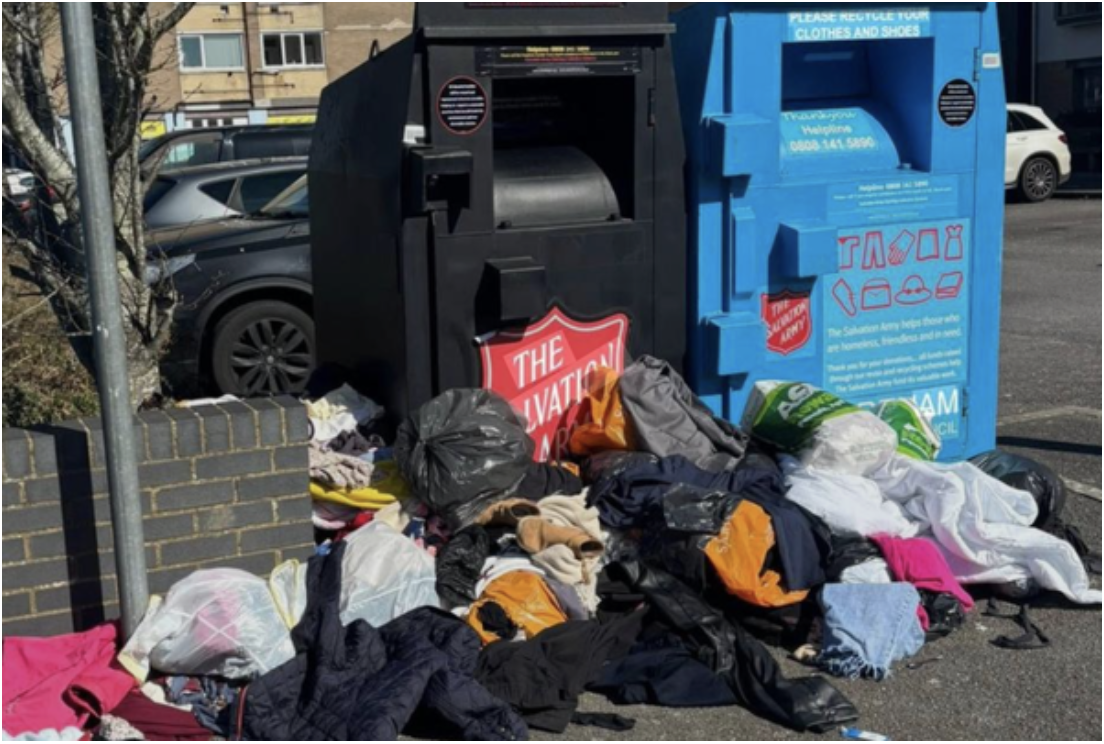
For years I have always put soiled or damaged items into my household waste bin. I can imagine many of you reading this do the same. But that will be because you work in the apparel industry. That's not what your average consumer does.
Unfortunately the meeting I was really hoping to happen last week, between charity shop managers, Green Party Councillors and The OR Foundation didn't materialise because of, well, heat. But the conversations I had running up to this paint a picture much worse than I had previously thought possible.
The first port of call for anyone whose got an item worth reselling it's Vinted. Charity shop managers in my local area, which has a higher disposable income than the average area in the UK, have said this has contributed directly to them getting poorer quality donations. And it's always a consumers first port of call for mid level products. Many expensive, designer items are likely to go on a rental platform to maximise their value. Which, in a cost of living crisis, is understandable from a consumer perspective.
These new ways to generate income for individuals has impacted the clothing being donated to charity shops. Not in terms of quantity, which is on the rise by 10-15%, as estimated by my local charity shops. But in terms of the quality. With an estimated 25% now going into the "waste" stream. And these numbers are being forecasted to rise. You can read a statement on this from The Salvation Army here.
(It would be remiss of me not to mention that there are other trends at play which always filter into second hand. The current "Ozempic" trend has seen an short term increase in larger sizes, and better quality clothes, coming through in the first half of this year. And so my comments around quality of donations is not as black and white as it seems.)
Even more concerning that the rise in both donations and waste, is the reduction in the money charity shops get from "recyclers", which has decreased by around 80% in the last 4 years. One charity shop showed me their accounts, where they received £25 for roughly 400kg last month, compared to £135 for just over 300kg 4 years ago.
Just as all trends aren't the same. Neither are charity shops. Some are behemoths with complex retail strategies, and avenues, not too dissimilar to retail giants like Marks and Spencer. Others, like the Salvation Army have embedded themselves further down the waste stream, which has seen their income rise by $2 billion per year since 2022. A % increase similar to that of Cancer Research, who are one of those behemoths. But a huge gap away from Oxfam, whose income has only increased 2.7% in the same period. Or the RSPCA, which manages a franchise structure, which has seen a 1.7% decline.
Clothes that don't get resold or sent to charity, become a local government problem. Not that the head of Waste Management in my regional area think that it is a problem because they "have a contract with Biffa who manages that". In my area not all our household tips have textile waste bins. My local tip direct soiled products to household waste (landfill / incineration), and direct people to the Salvation Army bins at the supermarket down the road for resellable products. The tips that have a textile waste bin go to Biffa, who then send it to The Salvation Army.
I know an awful lot of people who don't understand the complexity of textile waste, and think that if they put their soiled textile in the bin at the tip, they'll be recycled into new items. Whereas I know that textile waste from my town is ending up at Kantamanto market because of this waste stream.
*I say "I know" like I can prove it. I can't. And I can't because export documents in the UK are confidential information. I even tried asking a friend who manages the port authority if I could sneakily find out if a subsidiary of The Salvation Army called Kettering Textiles was exporting to Ghana. He said there was no way for me to get that information. So I don't know, but I would bet a decent stack of cash on it.
Now, we get to the real problem with textile waste. Kantamanto market is the largest second hand market in the world, as is largely seen as the gateway to Africa for second hand goods. The price of the 55kg bundles paid for by the retailers, designers and tailors there is rising faster than the price decline in the UK. This isn't greed, although some of the other issues these business face are, much of this price rise is to do with duty increases designed to limit the trade deficit.
We all know the narrative of Trump's tariffs. Let's make sure we apply the same narrative to both the US and Ghana. And ask ourselves why the Ghanaian government may want to reduce imports?
The tariffs are the first sign of a problem. The next sign that the shit is really close to the fan, is when the industry this impacts the most goes on a PR defensive. Let's look at a couple of messages doing the rounds at the moment, and decide for yourself as to how bad this really is.
First we have report put out by the UK International Development agency to look at the quality of second hand clothing being donated in the US and sent to Uganda and Tanzania. Most obvious is that US customers are not the same as UK ones. And their national infrastructure is different to ours. It's like comparing apples and oranges because they are fruits.
The second issue I take with this report is that they are not holding the same weight to different points of measurements. Just because something is durable doesn't mean it's suitable for the climate.
Yet it was a point in the conclusion that gave me chills. It summarised that an exporter could not be held liable for any products that were dumped for being unsuitable, or unsellable, because it was the importing country's government who was responsible for the disposal of the waste being sent to them.
Which seems to me to be at massive odds to this idea of the polluter pays principle the same people are pushing onto brands that make rubbish. The very people pushing the narrative that the waste textiles being sent abroad are not the responsibility of the sorter. Are the same people who would financially benefit from an Extended Producer Tax applied to Shein products.
Ain't capitalism grand, folks!
(Credit where credit is due, the report does highlight a couple of really important, positive points, around economic responsibility and that microfibre pollution could not possibly be the responsibility of anyone else but the brand.)
We then come onto some much more egregious. In fact, it's straight out of the British Colonial playbook.
Gaslighting.
The Head of the Textile Recycling Association in the UK has taken to Linkedin repeatedly over the las few weeks to claim there is no textile waste problem in Ghana, and actually its not clothes but plastic packaging.
This directly contradicts the lived experiences of those in Kantamanto, and the activists and journalist who have visited the area to raise awareness through The OR Foundation. Luckily, we have social media. And the videos / photos The OR Foundation put out on their instagram.
I've said it before, and I'll say it again until there is no breath left in me; we live in a post truth world. If we ignore the voices of those on the ground we will drown them in clothing. Or they will ban imports from us and we will drown in our own waste. Either way, at that point, it's just too damn late.
Can Clothing Performance Really be Tested in a Lab?
At a time when well know fabric suppliers, such as Polartec and 37.5, are moving away from lab testing to determine how a fabric performs, the JRC have released their latest DPP (Digital Product Passport) guidance which promotes lab testing. In a world of incredibly complex performance factors, how is this likely to play out?

Let's start with the good news! Based on the JRC's latest guidance, there are only going to be 3 data points to ensure product compliance. And this is based on a legal guarantee of a product lasting 2 years of use, under the Empowering Consumers Directive.
Now, using time as a measuring factor can be tricky. A formal dress, for example, will probably only be used a handful of times in 2 years. So the durability standards are lower than a pair of jeans, which, based on reasonable use case, could be used once a week.
Another example is, an entry level pair of cycling shorts wouldn't be expected to be worn on a 100km ride every weekend. But a mid range pair of cycling shorts with a long distance pad in, could reasonably be considered to need to do more than 120km every month. Why not every week you ask? Well, it would be reasonable to assume that someone that dedicated to cycling would have more than 1 pair of cycling shorts.
The 3 tests the JRC are proposing are; appearance after wash based on ISO 15487, spirality based on ISO 16322-3 and, dimensional change based on ISO 3759.
ISO standards are just the test method. They don't advise what the score should be. The appearance after wash is graded 5 -1, with 5 being the best and 1 being the worst. Spirality and dimensional change are reported in %. The lower the %, the better the product. In theory.
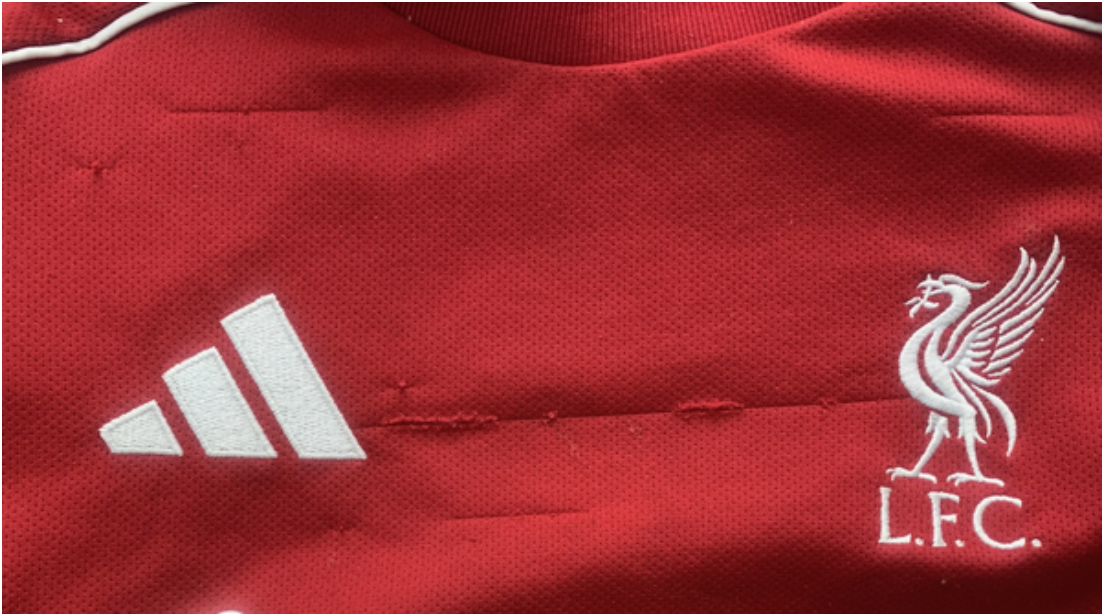
Tying off the good news here: we aren't going to be seeing mandated testing such as abrasion resistance and tear strength, which synthetics perform better at than natural fibres (providing they're made correctly, which if you read my newsletter last week about the Liverpool shirt, you will know isn't always the case! The photo below indicates that the appearance after wash would score a 1 for this!). And this was a concern for many people.
But why am I suggesting these methods, specifically the ones measured in %, may not be quite as telling as we hope?
The problem comes down to consumer's understanding of how a product is developed. It has been found in scientific studies that organic cotton has a higher spirality than conventional cotton, and so does mechanically recycled cotton. Short answer is because the fibre lengths are shorter, so there needs to be a higher twist in the yarn. On the DPP you will be able to see the % of recycled / organic content and the % of spirality, but no information on why the numbers are what they are.
It's the short answer because improvements can be made on the spirality by the method you use to spin the yarn in the first place. For cotton you have rotor spinning, or ring spinning. Ring spinning creates a better product, but rotor spinning is a lot cheaper. If you want to delve into the differences, this article is pretty good.
Then there is finishes to consider. Some resin based finishes may be applied to improve the appearance after wash score, that can degrade the fibres over time. Making them weaker and prone to tearing. This is where my brain combusts. I just don't understand chemistry, so I go to other people for this. In case you thought I was about to drop something really insightful!
And then there is how something is knitted or woven. Circular knitted single jersey cotton would have a worse spirality than warp knitted cotton. Now, guess which process is cheaper!
(Now, I know I'm going to get some emails on this from a few people, you know who you are! So I will caveat by saying that yes, correct finishing drastically reduces spirality on circular knits. But how many people actually check that before production? Yes, I know you do! But the amount of times I've been asked to help get a refund on cotton jersey that's twisted by 12% after 1st wash, is silly. And no, it wasn't a cotton jersey I sourced!)
All of this is, of course, based on 100% cotton. The easiest, and cheapest, way to improve the spirality score is......
Add polyester!
Which brings is onto why Polartec and 37.5 are moving away from lab testing (which ISO standards are designed for) and into product testing out in the 'wild'. Ultimately lab testing is designed to compare items under the same conditions. But they don't tell you how something will perform when you stick a human in it.
Take a waterproof hydrostatic head rating of 10,000mm. That tells you how much water pressure a fabric can sustain until 3 drops come through the fabric. But someone whose 100kg, kneeling on the ground, is going to have wetter knees sooner than the 60kg person. It helps the individual compare items, but it doesn't tell them how a product is going to perform for them.
It gets a whole lot more complicated when it comes to breathability. Which is largely a test I ignore on a product spec. The only time I look at it is in relation to the hydrostatic head to determine if the product will hold up better when submerged in water (a lower breathability rating that waterproof), or if it's designed for high cardio sports (a higher rating than waterproofness). That then needs to be tested in product form. As every individual is unique is how much they sweat and where.
Now we come to one of my biggest bugbears. And it's not calling bamboo a sustainable fibre! Its when polyester is used to make a garment and then that garment is Dry Clean Only!
Honestly, hands down, the most pointless and environmentally damaging product there is. But, it won't half score well on product compliance.
The Shein Effect? When the Premier League's a Rip Off.
If you've seen the FIFA President justifying World Cup ticket prices this month, you know it's not about football anymore, it's about profit. And it's not just ticket prices anymore, its kit as well.
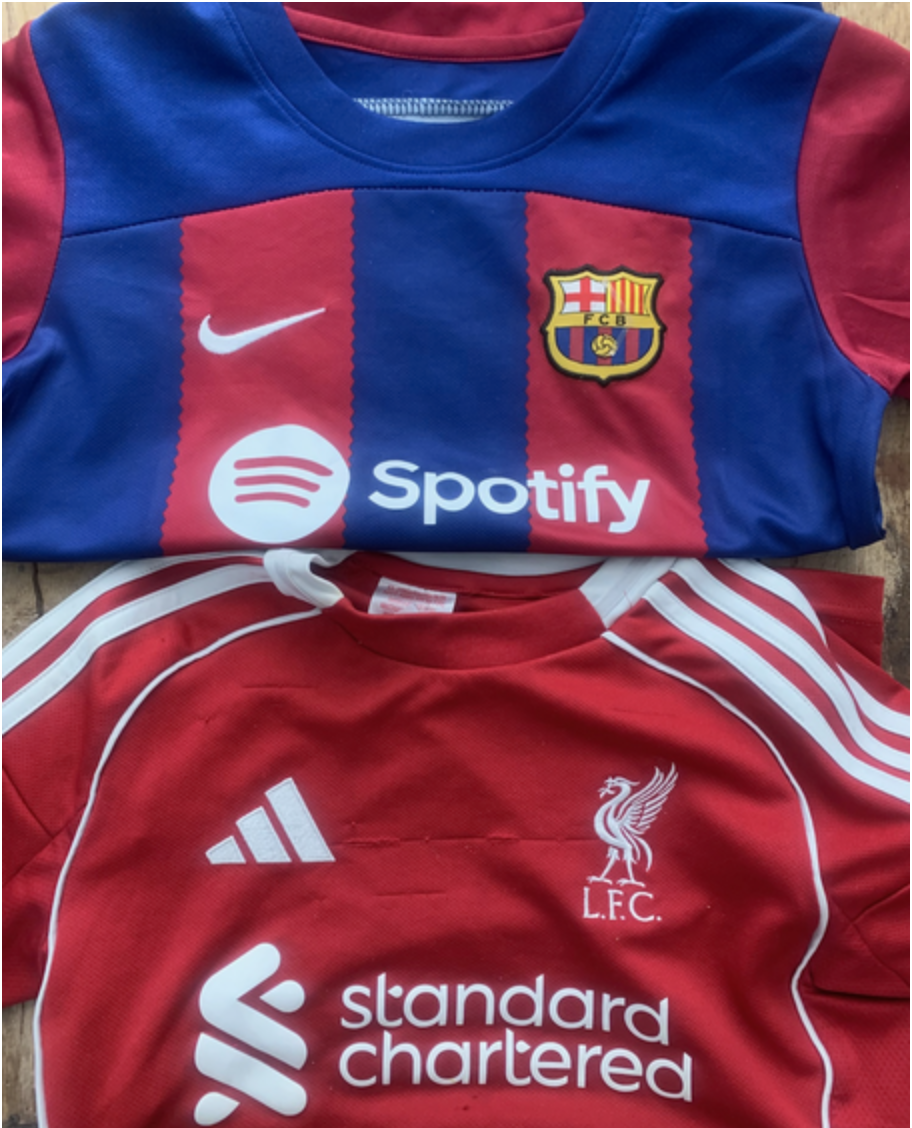
Before me sit 3 eyelet mesh football jerseys. 2 are £60 RRP Liverpool FC jerseys produced by Adidas. And one is a €10 FC Barcelona fake I bought in a Mallorcan market. The fabric's between LFC and FCB are very similar in construction and weight, and both are made out of 100% polyester.
The expensive Liverpool tops didn't last one wash before the yarns started pulling and breaking. 10 washes in and the fake Barcelona one looks as good as new.
In February of this year Liverpool announced their 2025 revenue was £703 million, and increase of £89 million, with £8 million in profit. Adidas also had a good 2025. An increase of 10% in revenue to €1.377 billion, with operating profit rising a whopping 54% to €2.056 billion.
But they have to sell you product that isn't fit for purpose. And wouldn't pass the EU ESPR.
I have known a fair few people in Adidas HQ over the years. And a topic of conversation has come up time and time again. Since Brexit, Adidas will dump their subpar product onto the UK, because that is the best legal option available to them.
Despite many an angry fan posting about the poor quality online, neither Liverpool FC or Adidas have commented on the poor quality of their products. Despite both local and national press mentioning it.
When I tried to return the first kit, I was informed that it couldn't possibly be a fabric fault. Instead stinging nettles were to blame. In winter. But Sports Direct don't hire their store managers for their intelligence!
So what went wrong?
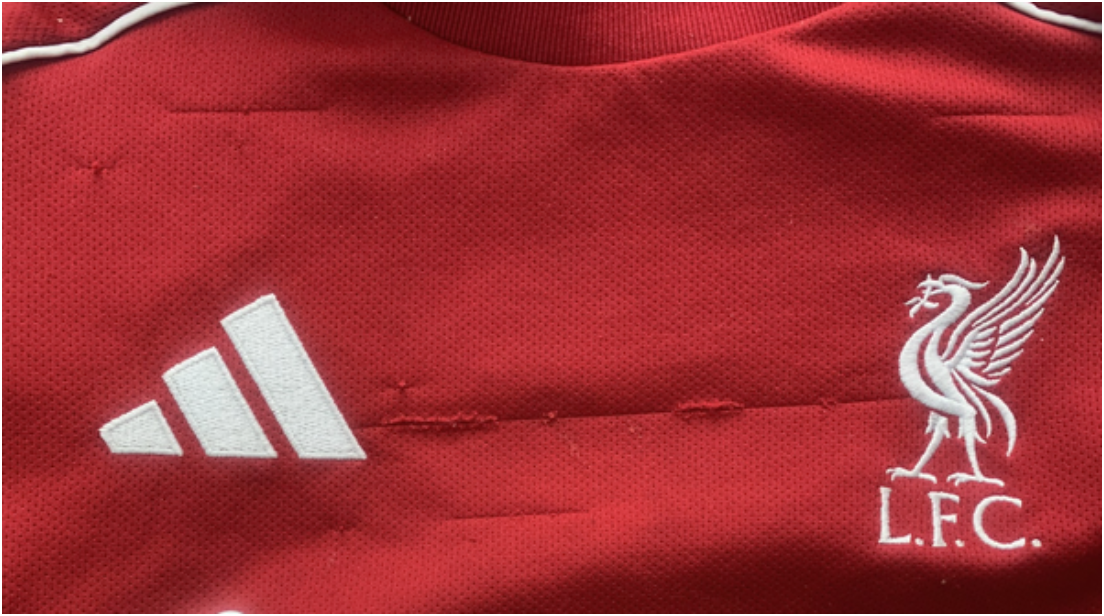
It's likely a multitude of issues, starting with the spinning and ending up in the knitting. Fibres are working against each other, causing tension and resulting in breakages. Which gets worse with every wash (unfortunately my son is a die hard Liverpool fan, so faulty goods are worn). And yes, the issue would have been picked up in testing. If they bothered to test it.
And yes, both the club and Adidas are saying these kits are eco-friendly because they are made from recycled plastic bottles. Clearly no one mentioned eco-friendly should also mean durable. Not to mention the level of microplastics that are coming off these shirts as they degrade every wash.
While consumer rights are consumer rights no matter the circumstance (and yes, I could have taken it to the Ombudsman, but I have chosen to make it my mission to shame Adidas and Liverpool FC instead. Because their fans are their profits and I have a bee in my bonnet about people being ripped off!). The problem that's not being addressed is what is going to happen to these shirts that are 1) unsold and, 2) not resellable?
This is where it comes down to who has the better negotiator; the football club or the brand. Because no 2 contracts are the same. Some clubs take responsibility for everything. Some, for nothing. One thing is for sure though, having a faulty fabric means that you can incinerate it here in the UK.
UEFA estimate that 60% of team kits are discarded annually. With 3 - 4 million kits destroyed.
At those volumes it makes precisely no difference if you are making it out of recycled or virgin polyester, if its' all going into rubbish. And its' environmental footprint is worse than that of the Nike kit. Or even the New Balance kit from 2015, which my son also wears and looks as good as new. Despite the hundreds of washes that's gone through, with him being the 3rd child to have that kit.
There is no reason that a football kit should not last the season. In fact, consumer law would expect exactly that. Some sports industry people have argued that football clubs are expensive to run. So it's more than reasonable that poor quality kits should be sold at a high price. But with Liverpool FC reporting rising profits against every single money making category, that sounds like bull to me. Especially when one kit has fabric faults before we even took the tag off!
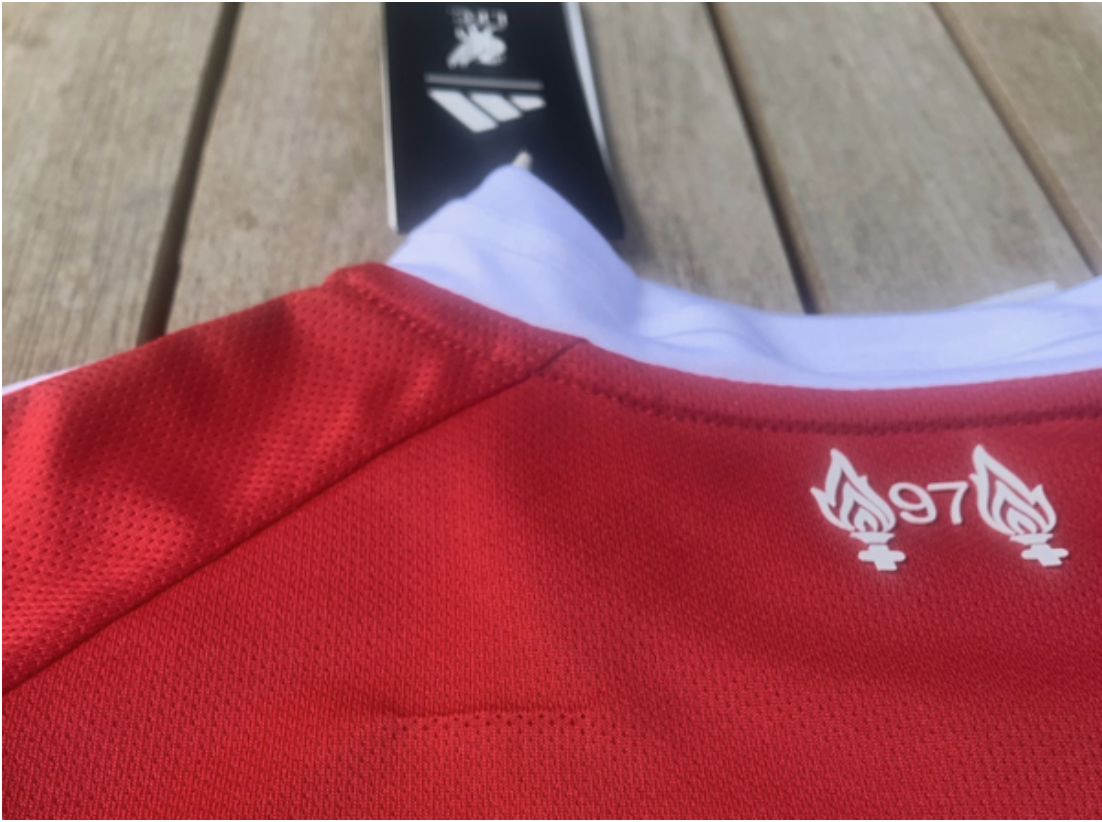
If Liverpool genuinely care about the fans or the environment, there are a couple of actions they need to take. First, they need to go back to Adidas with evidence that their products are not fit for purpose. A refund is due. And that should entitle fans who bought a faulty kit with a discounted 2026/7 kit (we'll brush past the fan's comments on design!). The club still profits off this.
A take back scheme through LFC for faulty kits needs to be organised, with a donation to the Salvation Army to recycle the fabrics. There's a great marketing story to be had there.
Liverpool FC should also take this opportunity to review their contract with Adidas. Because supplying faulty goods is going to be a breach, which ever way you swing it. Testing standards should be agreed.
And as a lovely cherry on the top, they should join the Microfibre Consortium Roadmap.
But I don't think LFC will do any of this. Because we're already seeing how financial reports take precedent over fans, the sport, or their local area. I would like Adidas to answer how they plan to ensure ESPR is applied across their global products. Because this could well be the first example of a 2 tier product system coming out of large European brands.
In the meantime, I will continue to take my son's football kits around with me, calling out the club and the brand at every turn. In the hope that other clubs learn from Liverpool's mistake. In September I am giving a keynote at Manchester Fashion Week on polyester. You can bet these are coming with me!
I will continue to expect silence from Adidas and Liverpool FC.
Trademarks, Patents and Common Sense as a Legal Argument
Laws are a funny thing. Because while we are constrained by them, we can only be constrained by them if we agree to them. Or rather, if the majority of society will agree to them. Another fact is that laws, or legistlation, are guidelines. It's the courts that set the precedent. In the last couple of weeks I've read lawsuits that cover trademarks, patent infringement and, "common sense" being used to terminate a contract without repercussions. Begging the question; how small do you need to be to lose? And what happens if we (the majority) don't agree with it anymore?
Let's start with the one you've probably read about. Patagonia, the outdoor brand named after a region covering the Andes Mountains, is threatening legal action against environmental drag activist for using their brand Pattie Gonia for merchandise. Now, for context, Pattie Gonia said to the brand, back in 2022, that they would not sell merchandise. But we all know that strategies change, as our "common sense" lawsuit, below, will tell.
Now, a lot of the recourse is around logos. Something which the US Patent office did not find confusing. Although, I will leave it to you to make up your mind.
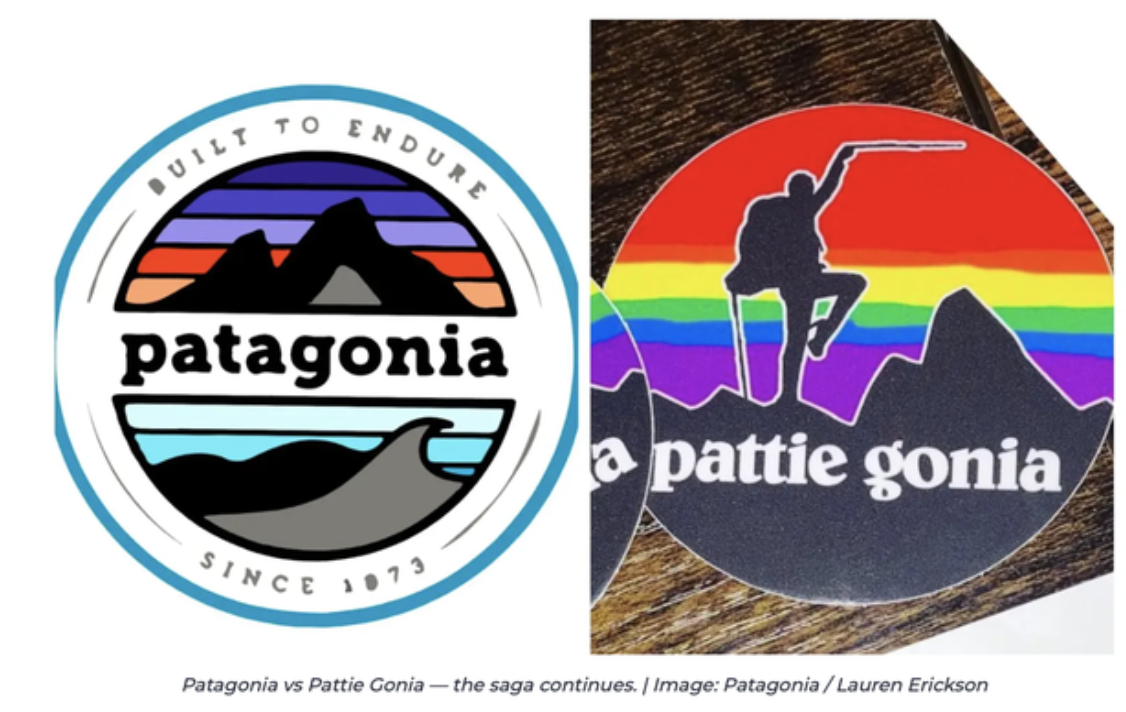
A fun fact, however, is that Patagonia make new outdoor clothing. At present, Pattie Gonia screen prints onto recycled clothing. Not new clothing made out of recycled textiles. Recycled clothing. While there is no doubt that an expansion plan is in place. Realistically, how infringed are Patagonia likely to be from merchandise created by a drag artist?
Intent is key, no?
And with that question we move onto the patent infringement. Shock Absorber, the revolutionary sports bra brand owned by Champion Sports, has infringed on a patent from another revolutionary sports brand, Maaree, who has a patented overband support system. Maaree turned over just over £300k in the year to April 2025. While we don't know Shock Absorber's annual turnover, it's estimated to be around £10 million per year. Just to give you an idea how big Goliath is!
Initially, when the founder of Maaree reached out to Champion, they said they would not sell the sports bra they ripped off from her in the UK. It has since been discovered that it is available for retailers in the UK to buy wholesale. Champion has not responded to the founder since this discovery.
It's easier to get away with design infringements today than 20 years ago. Those of you old enough may remember that River Island used to rip off All Saints designs, and then would pay All Saints out of court settlements. A friend, who was a buyer at RI at the time, said they had a fund just for this! This is where intent to copy needs to be proven. Which, fortunately for Maaree, there is the evidence, as a Shock Absorber employee ordered the copied bra to the brand's office!
Clearly much has changed in the last 12 years, when I worked for large brands you had to make sure no one could trace an "inspiration" sample back to the company!
However, how can a brand turning over so little compete against a brand that can bankrupt them in the court system? It's an interesting role reversal from Patagonia's trademark infringement. If both the large brands win, what does that mean for the rest of us?
This brings us onto the last legal case, which was heard in the Hague Court of Arbitration back in March between the governments of the UK and Rwanda. Rwanda sued the UK government for breach of contract over the Conservative government's asylum deportation plan. Which absolutely breached human rights at the time. And at a cost of £700 million to deport a grand total of 4 people, makes those hotel stays seem pretty cheap, no?
The Court agreed with the UK that, as Labour had won the general election, it was "common sense" that the scheme would be cancelled. And, while Rwanda's council knew getting a positive result on a breach of contract was unlikely, they did push for renumeration because no negotiations had taken place before outright cancellation. However, "common sense" seemed to be enough to let the UK walk away without paying out anymore money. Which is a win for the UK taxpayer under Labour.
It's worth noting, that in the UK and the US, you can cancel a contract without financial burden for a change in business strategy (although please check the wording in your contracts with a lawyer!). This fact alone helps Pattie Gonia with their lawsuit, because strategies have clearly changed between 2022 and 2026. And the law allows them to do that.
Intent forms the basis of many arguments, not just within brand protection, but also within ethical and sustainable fashion. Heck, it also forms the basis of most moral arguments as well! For me, it doesn't read that Pattie Gonia intends to look like Patagonia. It does seem that Shock Absorber did intend to rip off Maaree's designs. And the UK's Conservative government did intend to breach human rights laws and the Labour government intend not to.
We could go onto look at older lawsuits, such as the one being taken against Tesco and Intertek for human rights infringement. What is the intent of Tesco in employing Intertek? And what was Intertek's intention when undertaking an audit? And what was the intent of the Thai legal system to rule in favour of Tesco and Intertek when the manufacturing facility had the intention of fooling the Intertek auditors?
Our legal system is supposed to untangle these things and rule with fairness. How the legal system plays out with the business dealings of both Pattie Gonia and Maaree is likely to give us insight into how capitalism over the next decade is going to play out.
I'd like to end this rather bleak newsletter with a political conversation I had a few weeks back during campaigning. We, as individuals, have a hierarchy of needs. Water, food, shelter being the most important. For governments the bottom of the hierarchy of needs is energy and money. There are many different levers a government can use to balance those 2 needs. One that is considered is a reduction in human capital hours. On the Left this looks like a 4 day working week and a tax rise. Everyone in it together, and a push for spending through increased leisure time. On the Right, it's trad wives and a tax on the childfree. A not so in it together approach. But the outcome for governments remains the same.
So, the last question I have for you is, if the outcome rules in favour of the large brands in both scenarios; how are we, as consumers, activists, journalists, employees, going to engage with a world that no longer sells the dream of working towards a better life?
What Does Shein Get for Everlane?
Could it be all in the balance sheet?
By now you'll have read the headlines and seen the opinion pieces. "Everlane, Shein and the Limits of the Ethical Consumer", "Does the Everlane Sale Mark the Death of Millennial Sustainable Fashion" and, "Shein Buys Everlane: The Liquidation of Radical Transparency".
But what if this purchase has nothing to do with sustainability at all?
On the face of it, Shein does not need Everlane.
Shein have given $50 million to various organisations in recent years, that actually work to undo a lot of harm they cause. $5 million to the OR Foundation, who do great work, and this money has helped gain global traction for their 'Speak Volumes" campaign. (I'm not going to critise this partnership, even though it's glaringly obvious. The OR make a tangible difference, and sometimes, the end justify the means.) So, it appears Shein is already in a better position than Everlane from a pressing issue. On the face of it anyway.
Shein don't need Everlane's customers. According to the retail data, they pretty much have the same demographic. Given the % of people who consistently make good purchasing decisions, it would be like claiming the reason you can't get a job is migrants who brave the English channel. The numbers don't add up when you think about it.
Although, there could be an argument that Everlane helps a Shein customer feel better about their purchases. A pair of jeans from Everlane might make that t'shirt from Shein feel less... icky. But I still don't see how that would create $100mil in value.
There is always the possibility that they wanted to use Everlane's verification platform, or whatever they use. Sounds plausible. Until you get an email from a consultancy firm telling you you can now do your CSRD paperwork using AI. Shein is a tech company, so if they have managed to smash the consumer algorithm with AI, then I would guess they have some pretty clever people who can do just that with legislation? The other problem with this is that the Chinese government don't want foreign powers snooping around their supply chains. And ignoring the fact that, without RFID technology, I'm not even sure Shein could tell you which facilities in the Panyu District of Guangzhou make which styles.
Shein's production ecosystem is not the same as Everlane's. And again, technology is where Shein would win if they wanted transparency. As a tech company themselves, they are in a better position to build this than anyone else.
No, I'm not convinced it's any of that. I think the answer lies in the balance sheet.
The fastest way to "grow" a business is to either sell to another, or buy another. And this is becoming the playbook of late stage capitalism.
Or, there is a breakdown in goodwill from the Chinese government. And I've got money that it's one of these.
According to the Financial Times, Shein's profit dropped 40% in 2024, and missed it's own revenue targets by $7 billion. They have lost an IPO in both the US and the UK. It's the fact that they walked away from both these countries over transparency issues. Rumours are they are looking to Hong Kong next, after China also said they weren't keen. Some reasons have been listed as keeping out foreign influence over data and supply chains. But not exactly the radical transparency Everlane claimed.
Because Everlane is a private company, the turnover has not been reported. I asked ChatGPT twice, first answer I got was a $150 million higher than second at between $160-220 million. So, who the f*ck knows!
But if you want to raise your turnover by a billion, buying 4 brands for 40% of that outlay does make the business look more successful. It's the go-to solution for growing your turnover. It's why Wiggle purchased Chain Reaction Cycles. They needed to go from a £500BN company to a £750BN one in order for the owners, Bridgepoint, to make a sale. Even if that sale did result in the most dramatic insolvency in history, laid on a backdrop of corruption that spread across the EU.
Let's think about ASOS's purchase of Topshop for £265million in 2021. Saving the brand from liquidation. To only have the label's perceived value rescue ASOS from a Mike Ashley hostile take over a couple of years later by selling 75% (for £135 million) of the brand to the Bestseller founder. Some of that original purchase price went to loan repayments. Including £50 million to Philip Green himself (because he needed that). Whereas unsecured creditors did not see a penny. Including landlords and HMRC.
While we may sit around and say that a $90m debt is a lot for a brand with a turnover of £200m (ish). The majority owners of Everlane (pre Shein sale), manage equity capital of £39BN. So that Everlane debt is not quite what you'd be splitting hairs over. Especially when only $25M of debt belonged to L Catterton anyway. Even then, we don't know what has been agreed in the fine print of this sale. We don't know what debt repayments have been agreed, how much is unsecured, and whether any cash from Everlane is going to be transferred under this full ownership.
We do know that the debt acquired from leasing real estate has not been transferred over to Shein, as Everlane left all retail spaces and offices prior to the buyout.
Another problem that Everlane could solve for Shein is the small issues of US tariffs. For those of you not involved in the purchasing of goods manufactured in China, you may be surprised to learn that the Chinese government are subsidising tariffs through Chinese suppliers, who can land product cheaper than a US brand can. But only for brands they want to! China has invested a lot to control this access to the US market, but they can not make claims to have these tariff costs repaid. Who knows whether Shein has benefitted from this "investment in kind" from the Chinese government. But having a US based business that can make tariff claims for goods imported is certainly worth £100mil. We still have almost 3 years of Trump chaos left.
I don't know the answer to why Shein bought Everlane, but its not for sustainability reasons. I do know why Everlane sold out though. Because the founder had sold to L Chatterton. And you don't get to acquire a balance sheet of $39BN by having a moral stance.
The Microfibre Mysteries: What Are They?
Several weeks back, after a post by a researcher, Elliot Bland, at The Microfibre Consortium, I created a series of Linkedin polls to get an idea for how people understand terminology around microfibres.
I was reasonably surprised by the results. And I put them to Elliot, who may have been a tad more surprised than I was! But we both agree that this is really problematic. This is what Elliot had to say;
"Awareness around the topic is still developing, and the lack of consistent terminology is surely hampering progress. It creates confusion for the public and complicates efforts to develop regulation."
This is something a good friend of mine from The Knowledge Nexus, Niall Maplesden, agrees with. Although for slightly different reasons. One of his arguments is that no Jo Bloggs has any idea what 70,000 microfibres look like. Rather, we need to give it in weight. If someone wears a uniform every day for 5 days a week, and you are able to say that, washing this uniform every week for a year releases enough microfibres in weight to make a t'shirt. Well, then you (might) get them to change laundering behaviour. Or insist on better materials.
This newsletter is going to delve into the 4 terminologies I polled people for, and to explain why I view this. I didn't ask Elliot for his opinion on these terminologies, but we hold the same viewpoint. This isn't about things being right or wrong. It's about ensuring everyone is on the same page.

The view of myself, Elliot (and other members of the MFC), is that microplastic fibres are just synthetic fibres. It doesn't matter on their size. But, for arguement's sake, because the last option is a bit of a trick question as that size is a yarn density and not a fibre density, I (and it's just me here) wouldn't consider a continuous filament yarn to be a microplastic fibre. I think that would fall under general microplastic in the same way we view microplastic pollution for packaging.
If you have a sweater that is made of synthetics but is made to look like wool, and you pull a 5cm fibre from that sweater, that is a microplastic fibre.

The definition that the MCF hold is that microfibres are all fibres that are shed from fabric, not just ones that are less than 5mm in length.
And how you spin the yarn will impact how much microfibre shedding that we get. Which is often a whole fibre in the case of ring spinning, but a broken fibre in the case of open end rotor spinning, because this one has fibres wrapped around that are solely responsible for keeping fibres in their place. You can read more about how production process impact shedding here.
Defining microfibre pollution as all fibres shed from fabric is important when creating regulations for the production process. Which is where most of the fibre pollution is created, regardless of the spinning process.
One of the reasons I think it's super important to have a definition that covers all fibre compositions, not just synthetics, is that 90% of our dyestuffs and coatings are polymer based. Both pollution and degradation time is impacted by these polymer additions, regardless of whether the fibre is natural or not.

So this is the only poll where the majority and those from the MFC align! You could argue that this is a misleading question, given that broken fibres encompass all of the other 3 options as well! But I wanted to make the point that it doesn't matter at what point they break. (Although how you would know they were broken in some instances I'm not so sure).
However, there was a comment from a textile waste designer who pointed out something that is occurring in academic research. Micro is a measurement. But what we haven't defined is what is it a micro measurement of.
On reflection I do think that this is misleading of the academic community to use. Because fibres come in all sorts of densities and lengths. To put measurements on this could rule out a significant portion of microfibre pollution. So unless they plan on doing a study to ensure we capture all microfibre sizes and lengths, it's a semantic argument.

OK, so last one! I know this has been a lot!
The Oxford Dictionary has fibrous as meaning 'to look like fibres', and microplastics are synthetics.
This is a bit of a pedantic one in my opinion, which is why I put it in! Because, ultimately, we need definitions that hold our own industry to account, not encompass other other industries. Or perhaps move the dial on responsibility.
So in this instance, it's very much synthetic fibres that are used in clothing or other textiles. Plastic threads used in cables for example. Not our problem to solve!
Since this came out in the newsletter, and LinkedIn, the MFC have updated their glossary, so we can all be on the same page.. Because without centralised language, we won't be able to come to agreements on solutions or restrictions.
Thanks for reading this! Well done if you made it to the end! And a huge thanks for Elliot for starting, and continuing, the conversation.
Why NO ONE Really Wants To Onshore!
How many times, from how many people, have you heard, "bring back manufacturing"?

A series of undyed yarns are being fed off spools and into a weaving machine.
JD Vance gave a speech at the American Dynamism Summit earlier this year with a view on how innovation will support onshoring. Some of it was quite good, if you ignore the blatant lies about people earning more than the 70s (only if you don't factor in how much it costs to live now!), and the introduction which has an element of "arbeit macht frei" about it (the phrase above the entrance to concentration camps).
Additionally, I have seen a lot of noise lately around made in the UK. Lots of calling out of brands who don't produce here. And we just aren't having an honest conversation about how no one actually wants to onshore manufacturing.
There are 2 huge road blocks to bring back garment manufacturing.
Capitalism and environmental responsibility.
And that's before you have ICE agents in the U.S. arresting garment workers at their machines! You kinda can't onshore production if you don't have enough workers. For which one person on TikTok responded that we could just get the able bodied on benefits to do it. Ignoring that many reasons the able bodied are on benefits is for caring responsibilities. Or how much it would cost to train people up to do both the sewing and the care taking. Benefits are cheaper for the federal government in this case!
Which feeds into the capitalist merry-go-round, for which apparel is an avid rider.
Capitalism and political structure go hand in hand. People must not feel poorer. You can't have swathes of the middle class not being able to afford food. Quickest way to ensure political downfall. Just ask many of the recently outed political leaders. But if you can not reduce the cost of living. Then you must reduce discretionary spend products. You can make someone feel richer without actually making them so.
I saw a social media post the other month, where a woman found her basic strappy top from Miss Selfridge purchased 20 years ago. The price on the tag was £17. Today, a similar version can be found at most fashion brands for £7. (For context, inflation in the UK in that time is around 174%, so I am told).
What would happen if every t'shirt jumped £10 in price?
Which is what would realistically happen if we onshored.
And that's just wages and business expenses such as lighting and rent.
It does not cover the collective cost to the environment or people's health.
At this point it's prudent to link you to Ecotextile's article this week that highlighted how brands such as Nike, Lululemon, Hugo Boss, H&M and Primark have been accused of failing to factor in workers to their environmental plans.
Which brings us into carbon accounting and why no government, who knows climate change is real, really doesn't support onshoring. Particularly of very polluting industries like apparel.
The Global North have done a stellar job at moving our consumed carbon off to another country, and putting it on the balance sheet of the country it was made in.
In the U.K, our Net Zero targets won't be achieved if we start onshoring. And that's before we've even addressed whether our national energy grid could even support the level of manufactured goods being created in this country to make any of the training, or investment, financially viable!
In order for businesses to be able to invest in machines that reduce their carbon footprint, they have to ensure that they are being paid a fair price for their products. Linking us back to problem number one!
And even then, is it enough? I'd like to give a shout out to Atkinson Dyeing in the U.K. at this point, for the massive investment they have just done to reduce gas by 20% and electricity by 10%. Which is great when you view that on a single unit, like 1m of fabric. But if they suddenly get an additional 20% of orders. Well then their business footprint has just gone up. The system needs growth in order to support the investment, which then wipes out Net Zero gains.
Water is another resource that is under intense scrutiny within the industry. And in the U.K. we still use the Victorian sewer system. Which was built the same year as the first commercial oil well was drilled. And the year before the American Revolution started. Thems some old pipes down there!
The U.K at that point had 20.1 million inhabitants. As of 2023 there was 68.35 million. All of whom need access to clean water. (As an entirely different point, but one worth considering, I once had a conversation with a friend who told me it's barking mad that we flush our toilets with drinkable water. He's not wrong.) And for anyone not U.K. based, if you visit don't take a dip in our waters. That Victorian system means we shoot water waste into the sea.
We are not able to suppport onshoring without major innovations happening. Perhaps we could become the sublimation capital of the world! Only near the sea though. Do you know how much energy it takes to move wind power across the nation?
In both the U.K. and the U.S., there is no money in the pot to bring back manufacturing that has already left.
We can, however, support the manufacturers already here. While we come up with a plan to replace capitalism.
In other words, support small brands and try to get large plans to plan for degrowth. And be mindful of whether you are being pulled into a narrative that demonises others under the guise of protectionism. The system is the problem, not the people in it.
*I am aware this topic is heavy. I feel depressed having finished it. Which is not what I wanted to highlight this for. Supply chains are complex. And you should not get hung up on any one particular point. If you have good suppliers abroad, especially if they are more skilled than your country, it doesn't make sense to move it.
Decoupling Production Units From Turnover!
I think we would be foolish to look at the current economic hardship being faced across the middle classes in all Global North countries and not realise that our businesses are at risk from continuing with a business as usual approach to production.
Business as usual has us producing more units per style, and putting more of them into sale, than ever before. Full price sell throughs are down. The number of units that are never sold is up. And it's not going to be long before those tax reductions for stock dumping through charity donations or recycling will face the chopping block as tax incomes decrease.
If at this point you are wondering why we aren't seeing a natural bell curve around a decrease in global spending against the back drop of falling incomes for the middle classes. This is where I tell you that this is because the top 1% increased their spending last year by 10%.

A pile of branded boxes piled up in a delivery van.
Trump said it really well. "Perhaps kids will have only 2 dolls now instead of 30." But those that can afford it can now have 2 mega yachts. And this is where I would like to point you to the work of Gary Stephenson and Grace Blakely. Who are both UK based, but economies in the Global North run on Oxbridge Economics. Probably one of the UK's most successful export. It's why our exports are dominated by financial services.
Inequality is growing, the middle class is shrinking, and while the wealthy class is not growing by number of people, it is growing with how much income each person has. So how do apparel brands, and manufacturers, who cater to the middle classes survive? It's not by doing the same thing as we've previously done. Which is increase production units to get a better per unit price, but then put more of them into sale. This is also a very new thing. At the time when I was developing millions of pieces for the UK High St each year, no buyer of mine wanted their products to be discounted. We had sale buys for that. Sure it helped styles that didn't land. Fashion is gambling after all. But you wanted full price sell through on products that you had spent time developing. And discounted products were made cheaper.
Now though, we've reset consumer mindset and are too heavily focussed on instant gratification to make sales. It's this mindset that has helped grow Klarna into the massive behemoth it is today. Because why on earth are people using Klarna for their £17 Sports Direct t'shirt that we all know is going to be £8 next week?
And this doesn't just impact fast fashion, or businesses producing cheap products. This week I did an exercise on what a North Face jacket would cost in the UK 20 years ago (price range was between £80 and £120 back then). Today, a £80 jacket is around £110. If we were to accurately cost this product, based on inflation, it should be £219. Now actions have been taken to reduce this cost along the way. Production has moved out of China in that time to Vietnam, Cambodia and Bangladesh. Countries that have preferable duty rates compared to China (obviously ignoring the last few months). We've seen the number of sewing minutes reduced as the outdoor industry has moved from 2 layer fabrics that needed a lining, to 3 layer fabrics. So while not a fair representation, one that, I hope, goes to demonstrate we aren't paying enough for our clothes.
So how do we combat this is global transfer of wealth in a way that can ensure businesses survive?
Firstly, we have to get off the overproduction train. And the goal with this is to increase full price sell through. So that means more frequent drops of smaller orders. If you are a garment manufacturer and you've just thought "no way", I'd like to introduce to Manny AI. Not only is this a great solution designed by people who ran a factory (and also advised by yours truly! Sorry for the services plug there!), but it is also affordable. While the current solution is fab, their plans for making the platform work even better, are wonderful for ensuring fair wages, but also for upskilling. You won't regret checking them out!
What we want to avoid in this reduced production scenario is having excess inventory of fabrics. While Shein lauds its reduced volume for the production of garments, it entirely ignores the fabric side, where 2000m are being ordered for 200 dresses. Hence the deal with Queen of Raw a few years back. While I will not shade Queen of Raw, seems a good time to reiterate that using deadstock is not circular. And we can do that by printing over solid dyeing. In all cases an all over printing method has lower environmental impacts than dyeing. (Caveating that some placement print methods have a very high environmental cost such as foil and flocking). Holding prepared for print fabrics is much less financially risky than committing to 500m in Aqua Green.
We then have the many R's that need to be addressed as part of this strategy; Returns, Rental, Repair, Resale, Remanufacture and Recycle, as part of the ability to monetise products further. It would not be viable to try implementing all at once. Which is why I so often say we need to plan for degrowth (or economic collapse!). Did you know that, while Klarna say they can increase spend by 47% by using there service, they fail to mention that returns increase into the 70%? That's just bad for business.
(As another shameless plug, I'd like to mention the time I reduced Zone3's swimwear returns rate by 40%! So if you want to review your returns, do reply to this mail!).
Now we aren't going to eliminate returns in it's entirety, and I know that some of the returns can make you question how far we have come with cleanliness. Having a system in place to use these returns as rental is beneficial. Especially because you don't need to reprocess until you have sold something. Unlike a return to sale.
I'm going to brush over repair and resale, I feel like they're self explanatory, and this newsletter is getting long. But I want to add that, when it comes to resale, getting a better price means selling it to the right geography. The idea of Grade A products being sold for more in Eastern Europe as opposed to Africa no longer holds true. Something I learnt only recently with The OR Foundation and Finisterre.
Recycling.... this is one where deals are going to be able to be had more into the future than now. The demand for good quality feedstock is growing. And we aren't producing enough of that. Remanufacturing will help solve the problem we have with blended feedstocks, although I'm not quite sure how easily that is going to be monetised. The win will be in providing recyclers with the good quality feedstock and negotiating on the weight of fibre you buy from them.
If you would like to book a £200 strategy session to assess how you can generate more revenue from products, hit the Direct Line button!
Sourcing: More Strategy Than A Game Of Chess
"Well, that's new." Every season, something happens that has never happened before. And I never foresaw coming.

A selection of wooden chess pieces set against a blurred out background of an open door and dark walls. Image source: Unsplash.
There was the time the roof of the factory was blown off in a hurricane. Or the time we had a fabric order short shipped, so the factory made the trousers 2 inches too short to achieve the order quantity. The time 8,000 pairs of Debenhams trousers went up in smoke in a riot. The time a pallet of socks was stolen by a gun smuggling gang (I kid you not, that is a true story). The time that none of the 10,000 jackets were waterproof, despite the SGS test reports.....
The one thing that this has taught me is "the best laid plans of mice and men often go awry" (Robert Burns "To A Mouse"). And, to tug at any thread you even get a whiff of. Which came in handy with a client last week....
There is a well known supplier of sports and athleisure fabrics in Lithuania. Who claim they are able to make merino baselayer fabrics. Now, merino in and of itself, is a minefield. Only last week Peta made more claims to the New Zealand Merino Association about animal cruelty on farms. They just weren't able to specify a particular farm, or farms. The problem with wool, and sheep, is that these abuses are indeed, often, rife. But the lack of understanding of how wool is priced leads to all sorts of conflicting claims. The film 'Slay' made heavy claims about the wool industry. While showing sheep that are bred for meat. It's a bit like cars. If the wheels on it are cheap, you don't mind when your other half scrapes them along the curb, even if it has the most expensive engine inside. But if they're the most expensive wheels with a cheap engine, you'd struggle not to lose your cool when you hear the grating! Same with sheep. If the fleece is the thing of value, you care for it.
I digress. My concern with this supplier is that they do a bit of everything. And when it comes to wool; I like a specialist. But, I do my due diligence, and the wool certifications seem legit. They will even let me nominate a yarn supplier. But the supplier had said to my client that they could make finished product as well. And achieve both price and volume out of their facility in Uzbekistan. Now, if you've just raised your eyebrows at that last sentence, I can make a good guess on how long you've been in this industry! And that was exactly my response.
I started out asking for the audit. Nothing. I ask for them to confirm how many representatives of a union, and which unions. Nothing. I reiterate the EU Forced Labour Ban and my need to confirm that this is something I can verify. The response I eventually get back was that they were unable to provide me with wool products out of Uzbek due to "some restrictions". Sorry, what now? There are very few restrictions out of Uzbek using fabric made in Lithuania. And none containing wool.
So naturally, I went and found the export information. Do you know the countries where wool apparel from Uzbek are exported to?
Russia, Belarus and Georgia.
And do you know which industry complex imports more than 70% of wool apparel products since 2022?
The military.
I mention this to the client, who said, "ah, they mentioned about being a defence contractor".
I was regaling this story with some friends that work in the alcohol industry, over a glass of wine. When one, from a very well known producer, said; "there is no shortage of alcohol supplies into Russia. It all flows through Lithuania."
In the end, I recommended a supplier of my own. We did the pricing work, using a fabric mill I know I can trace fibre back to farms, and provide certifications. So alls well that ends well. But it got me thinking how hard it is to source products these days. Back in 1992 my dad went onto a 2m x 2m stand at Ispo with a wall full of sleeping bags. He thought they looked alright, so he placed an order. 30 years later and that person he met is the CEO of the largest sportswear manufacturer out of Bangladesh, who also manages H&M's chemical recycling facility for poly cotton. The chances of that happening now are unbelievably small. Eusebio's relationship with my father lasted until he retired. And some of my suppliers today are ones started by people who used to be production managers of suppliers used by my father. The very people who taught a teenager how to seam seal a jacket!
No one really taught me due diligence, so I'm not even sure if there is a prescriptive method that's used today. So, instead, I recommend reading the audits (all of them, not just the headlines). I use Google Maps to understand the local area, not just for other suppliers, but how much people need to love there. I use the Asia floor wage and living wage data. I use export paperwork and cross check against brands supplier lists. (I remember finding a supplier who sent a container a month of finished goods to Puma, but they weren't on any supplier list. Always a red flag.) I cross check certifications. And if I know other customers or their suppliers, I ring them up and ask about them. I make sure I know what, and how many machines they have, who the union reps are, and from which union.
But none of this is foolproof. The best checks are still to turn up when your products are being made. That has been where I have found most violations. This industry, at it's heart, is a human one. And clothes are a bi-product of that. For all the talk of technology, AI and robotics, I don't see that changing anytime soon.
Lack Of Data Makes Investment In The F2F Industry Risky.

Do you know what blew my mind this week? Like, really blew it. Blown in a way that I haven't experienced in years.
I realised that our data gap within production volumes makes investment into any fibre to fibre recycling doomed to fail.
On Tuesday this week I was invited by Adele Gingell, Head of Positive Impact at Finisterre, and Venetia La Manna, fair fashion campaigner and influencer, to an evening with The OR Foundation. The founder of The OR, Liz Ricketts, very accurately described the problem we have with this data gap.
Now, if you haven't heard of The OR Foundation before, they are an organisation who support designers and retailers within Kantamanto market, which is the largest second hand remanufacturing and distribution centre in the world. If you work in the creation, or sale, of new apparel, you should check out their website, because your products are handled by them at some point.
Liz pointed out, that if we don't know how many garments we produce, we can't have a plan to effectively manage them. And so they have created a campaign called Speak Volumes, which aims to get brands to list their volumes. Finisterre were one of the first to do so, off the back of their customers calling for it. H&M also released their production volumes this year. With new financial reporting standards coming in across both the UK and the EU over the next few years, brands are going to have to report on this eventually. The OR are giving brands an opportunity to do so as part of a sustainability strategy, through their campaign, first. If your customers are mainly Millennials and Gen Z, given the data we have on their buying habits, I would strongly urge you to consider getting on board with the Speak Volumes campaign to get you some brownie points in advance of mandatory reporting! You can't retroactively get good will on this!
When Liz explained the impact of the data gap on them and the businesses they support, I realised the problem was also going to impact investments in the fibre-to-fibre recycling space. And that if we don't get a grip on this, we will not have a F2F industry that isn't propped up by the packaging industry. Meaning the only recycled fibres we'd be getting would be polyester (PET) ones.
Could you imagine any other industry, or product, that would get millions in investment when they couldn't tell you how many products they have access to? If you don't know how much raw material you can get, you don't know how much you will get out. So you can't tell how much money you can make. Let's not forget that Renewcell went bankrupt because they couldn't generate the volumes they said they could (yes, sales also feeds into that, which I'll address shortly).
*We also don't accurately know the weight of textiles either. So while only the the garment production stage in textiles is where we use pieces over weight, we still wouldn't be able to know how much weight we have access to without knowing the pieces. My career really started after 2008 financial crash. This was a period where we stripped weight out of fabric in anyway we could. This doesn't happen a lot now because you couldn't take anymore weight out before becoming an Emperor's New Clothes scenario! So we need the data in both forms.
And this brings us to the pinch point we have between businesses in Kantamanto, and F2F recyclers. They both need good quality, uncontaminated, products. F2F is a great solution to cutting room floor waste. But when it comes to the best end of life solution for garments, in an ideal world they're heading to Kantamanto first, before heading into a recycling route. (This, incidentally, is why I think we need to do away with our current methodology for LCAs, but that's for another newsletter, we'd be here all day otherwise!). This creates a problem for the possibility of resale of recycled goods, which is already impacted by the fact that second hand and remanufactured only has one HS code. Which is something I did not know until Tuesday. Making it really difficult to extend the life of any apparel product. Take Sodra, the Swedish pulp maker, as an example, they raised millions to recycle post consumer waste into MMCFs. It was discovered, a few years later, that they were making virgin fibres, not recycled ones, because they couldn't get the feedstocks. While today they do have access to those by recycling hotel bedsheets (not quite what investors were told initially), they still have some issues in getting the products to market (again, that's another newsletter in itself).
Waste is a product of creating anything tangible. Even the designers remaking products in Kantamanto create waste. But we can't accurately understand, or plan for, that waste if we first don't know how much we make. If you think about it, we know exactly how much we waste we create on the cutting room floor (or your manufacturer's do), because there is a fee build into that for responsible disposal. (If you're factory is not responsibly disposing of said waste, you need to be reviewing an open costing with them. Because that's an indication you could be paying too little for your products. Reducing the weight of fabrics is a corner cutting exercise for cost, illegal waste disposal is caused by the same thing).
One of my first newsletters was about waste, and how we don't measure it accurately enough. I've put it up on my website, as this newsletter has grown significantly since then! If we don't want to be in a WALL-E situation in the next 10 years, we desperately need to get a grip on our waste crisis. And that starts with accurately reporting on how much we generate in the first place. And we have that information to hand already.
Do Contact Us if you don't have a waste strategy in place, or you want to review it. This can be built into material roadmaps really effectively for future product creation. But we also need to deal with historical stuff at the same time. Remembering that early adopters get to market it! And do get in touch with The OR to report your volumes, #SpeakVolumes.
Whose Waste Is It Anyway?

Do you know that we only measure household waste? And that figure (2.12 billion tonnes per year) is a best guess? There is no waste figure anywhere that factors in the production waste before the item has been purchased. What we do know for a fact however, is that we create more waste in the production process than we do at home. By around 3 times as much. The UNEP has estimated that we will spend $272 billion, globally, on waste disposal. Which rises to $361 billion when you factor in other externalities, such as water contamination.
In apparel production, waste happens at every stage of the process. Farming (extraction), ginning (extruding), spinning, weaving (knitting), dyeing, sewing, retail and, end of life. If we were to truly measure the amount and cost at each stage, we may reassess our consumption.
And yet consumerism has hijacked terms such as reduce, reuse, recycle and compost. Helping us to relieve our climate guilt while still consuming. Like textile recycling bins in stores. Recycle something old, buy something new. Which is all fine and well when we only address household waste. And not the waste that was created in the process. Because waste is not free, it has many hidden costs.
Perhaps it is time we start thinking about our waste as archeologists. Writer and historian Rebecca Altman describes our consumption as "time bombing the future", in relation to the synthetic chemicals. We can talk about biodegradability all we like. But when scientists took a core sample at a landfill site that had been shut for 20 years, they discovered newspapers that were still readable, and carrot tops that looked like they'd been cut of yesterday. Which makes a little bit of a mockery of anerobic digestion of biodegradable synthetics. That many, from yarn and fabric suppliers will tell you, unofficially, is greenwashing.
Cirpass, the EU's pilot project for the implementation of digital product passports, is looking into whether waste should be reported on. So far, stakeholders have said that it has a considerable barrier for reporting. But I suspect we don't have a full picture, and when we do, it is not one we will want to be known publicly. So I make a stake that it will not be included in DPPs. But we should still look at how we reduce it. Because, while it may remain a business secret, it impacts us all as humans.
During the 1980s, Japan was losing their manufacturing capabilities to countries with cheaper labour. In response, Japanese industrial designers started a zero waste movement as a means to reduce cost while keeping the quality they felt they couldn't sacrifice. What if, once a design student had made a design, they were tasked with reducing the waste of that product further? I am able to speak with experience on this point. Once saving €12 on a tri suit by moving some seams around to ensure we had maximum efficiency on the very expensive and narrow gripper fabric. This is the very work that Holly McQuillan and Timo Rissanen work on.
But even with reduced waste pattern cutting (which is a lot harder than it seems, especially with a size curve), there is a catch 22. The more we make, the better the consumption rating and the reduced wastage. In an ideal world we wouldn't have so many different fits and sizes, and clothes would be much more adaptable to different body shapes and fit desires. Perhaps something else we could task design students with; how can you make a garment fit 3 different sizes without using elastane?

The simple truth is that doing business creates waste. Even if you are a consultancy, and not the business charged with creating a tangible product, there is still waste generated. Wasted energy, wasted technology, and wasted office equipment. One of the simplest things we can do as a business is engage with refurbishers to extend the life of our office equipment.
While EPR rules often cover banning the destruction of unsold goods (this is the case in the EU, but not in the US yet, and is not included in California's new textile EPR). What our waste problem is telling us is that there is no such thing as a circular economy when waste is still coming out of the system.
But reducing waste is good for the bottom line. Even though you may not see waste disposal in your open costing, it is in there. So, you've made it this far! Now I'll give you some bullet points on immediate actions you can start today to improve your waste problem:
1. Get your designers to review old styles based on a zero waste pattern cutting method as the starting point. I would start with carry over styles and popular sellers first.
2. Map your supply chain! Inputs, outputs and what happens to them. You'll need this from Tier 0. Yes it's a massive body of work. And it would take me around 4 months full time to do it for a medium size brand (I normally do it as a project basis over 12 months and I charge £6,000 for this currently. If you're interested!).
3. Map waste by style. Which is something you can start doing for your season that is currently in development. Don't ask your suppliers to map the waste stream of old suppliers unless you're going to pay them a consultancy fee for doing it please. You can build data collection into new workflows, but back dating it is unfair without compensation. You wouldn't go back to your old job to data collection on that role without being paid.
Having this information to hand will make your teams better decision makers in regards to waste.
Microfibre Pollution: How Can We Stop It?
Why should we care about microfibre shedding now? Microplastics (of which synthetics are some) have been found in human brains, testicles and placentas. At this point, it's endemic. And we have no idea of the problems it may bring us. So it makes sense we should be doing something to limit that. But how?
The one thing that I can tell you, with absolute certainty! Is that most microfibres are shed over the production process. We can talk about consumer laundering until the cows come home! But that is not the most polluting part. (Which is not to say the washing machine lobby were right to pressure legislators to not mandate filters in machines. That was absolutely the wrong thing to do. But not because of water pollution. Rather because of what we do with the slurry that microfibres find their way into our food and soil systems).
So, what can we do about it?

Firstly, the choice of fibre makes a difference. The longer the fibre the less likely it is to shed. Using a fibre that is less likely to break during wear and laundering is also better. For example, using branded Lycra over standard elastane will improve the longevity of the fabric (if you have to use stretch at all, of course!). Some generic elastanes don't last long before they start to fray out of the yarns. Unfortunately research has also shown that mechanically recycled polyester fibres shed more than virgin ones. Mainly because they aren't as long. Unfortunately, not much research has been done on what cocktail of fibres produces more, or less, fibre shedding. Most research focuses on compositions of 100%, mainly cotton or synthetic. Research released last year looked at the impact of adding a small amount of elastane to polyester fabric. That research concluded that just by adding a small percentage of elastane, more microfibres were released during laundering than if it had been a 100% polyester fabric.
The size and twist of a yarn also makes a difference, using a finer yarn with a higher twist will reduce the amount of shedding, the twisty simply by holding the fibres in, while a finer yarn has less friction and room for fibres to move against each other. The method you use to spin the yarn also has an impact on how many microfibres are released. A study I read a couple of years back found that ring and compact spinning were better for cotton in terms of fibre release, but for synthetics air jet was better than ring spinning. In all instances open end spun yarns were the worst for microfibre release. I'll give you 3 guess which one of these processes is the cheapest!
You guessed it, open end spun is the cheapest. Open end spinning often results in a fabric that pills more too. Something that is worth keeping in my when the PEF (product environmental footprint as part of the ESPR) rears its ugly head again. If a fabric has a terrible pilling rating, you can kinda conclude that it's shedding lots of microfibres! Acrylic fibres are the worst for microfibre release because they are open end spun
When it comes to fabric, we don't have a lot of information to take on. Especially when you factor in how little is know about how fibre blends impact shedding. We also can't agree whether woven fabrics or knitted fabrics release more! Although, again, that seems down to fibre type with polyesters shedding more in wovens than knits, but it being the other way around for cottons.
This, I'm afraid, is where I roll my eyes at Polartec's ShedLess technology (and yes they've trademarked that!). Having had the opportunity to review the process in-depth as part of an award, what I will say is that there is nothing revolutionary about this. They use everything in this email and that's it. In fact, as one esteemed colleague said to me; "they're just making fleece how you should be making it in the first place"! But, if you're in outdoor and don't have the capacity to make these changes, then it's going to be a pretty great buy.
How we dye and finish our fabrics also has an impact on how many microfibres are released. Any stress put on the fibres weaken them. Be that combing, brushing or dyeing at high temperatures (there is even a study that shows how increasing the domestic wash temperature of a fabric increases the amount of microfibres released). The less stress we put a fibre / yarn / fabric under during these processes, the less they are likely to release. But without having done the work up to this point with fibres and yarns, really you're just tinkering at the edges. Equally, but the same logic that says the more you wash something, the more fibres are released, then that same logic would apply to the colours you chose. The darker the colour, the more dye baths needed to achieve the required shade, the more microfibres released.
Something that this report did throw up that I didn't know beforehand is that laser cutting or ultrasonic cutting showed much less fibre shedding than conventional cutting. Great news for those in the cutting room who may have the "poly lung" cough (I don't actually know if this was a thing, its certainly something many of us would refer to at Dewhirst after cutting PV fabrics all day!). Although the report did not mention how sewing is likely to impact microfibre release. Every time a needle goes into a fabric, you are puncturing it. So logically you could make the assumption that the more you puncture something, the more likely it is that it's going to shed. How that could impact over different stitch types does not seem to have been studied as far as my Google searching has been able to tell.
So how does this all work when all the factors we want to be using more of are more expensive, but we're all still in a race to the bottom?
This is where we're going to need to "take a view" on things. Price and microfibre wise, it would be more cost effective to use conventional cotton (they have longer staple yarns than organic) and ring spin them. If you want to have a certified organic product, then it's worth using Cradle to Cradle dyes on lighter colours and spin in in the open end method. Good marketing will help feedback on what your customer values. The first option will last longer (with the right care) and the latter will be better for the environment.
This also solves some of our price problem. I always come back to what Nicola Torreggiani from Guess said; which is that it's very difficult to justify a price difference on a pair of jeans for just organic cotton. But if we have them the same price, one is designed to be worn for longer, and the other is better for water and soil. Consumer choice is easier. And we don't want to be splitting these sales forever of course, eventually you are going to want to drop one and consolidate. If you know your customer well, then those choices are already an easy one.
A lot of what brand's miss in their marketing these days is using education to inform customers of why their products are better. Stopping microfibres shedding out out clothes does make them last longer, and you can test for it to ensure you're operating within the Green Claims Code. Unfortunately, it's very evident that a lot more research needs to be done in this sector to help us make better choices. But we have enough information to start, and direct comparisons in order to be able to test. I just wouldn't do it on blends yet.
Before I started this article, someone hoped on my Linkedin post to comment that this was being regulated under the ESPR, EPR and DPP. Which sounded completely wrong to me, because the EU are not anti business. In fact, quite the opposite. So obviously I had to dig into that!
Before we dig in, there is a word of caution I want to give. The EU legislation is guidance to the courts. It's the courts that set the precedent, which becomes the foundations of law. A good example of this is the GPSR. There were some UK industry bodies advising brands that they had to hold the same information for their licensed product as their own products. I advised a brand that this was simply not the case, but that they should have a strong contract that set out standards and compliance responsibility. Only last month a court within the EU set the precedent for the procedure I suggested. The sole reason that I could be so confident in my answer is that it would make it impossible for businesses to license brand names, and would put that sector out of business within the EU. And that is the same reason I can be so confident about the comment saying microfibres are being regulated. That would be anti business.
Now, that's not to say that is always going to be the case. We know that the EU is committed to tackling the microplastics crisis. But, most of that, as Veronica Bates Kassatly rightly pointed out, is packaging, and not fabrics. Then there is another pillar of the textile waste strategy that addresses plastic pellet loss. There's a beach in Scotland that is covered in them. The point at which they've solved that crisis, we may well find ourselves at the end of a stick. I would wager thats a long way off and we will have improved our processes by then. Although, as plastics, that only relates to synthetics. Which, as it stands from the end of last year, studies on microfibre release from these fabrics has only been conducted on mono-component fabrics. There is only one that addresses a blend, and thats polyester elastane. With elastane in only small quantities. Nothing like you would get in a pair of compression tights, for example. What the researchers found though, was that adding elastane increased the amount of polyester microfibres that were released during laundering. But with only one study, all we can conclude is; more research needs to be undertaken around blends. And, as the EU has committed to using "the best available evidence and analysis" when setting requirements. There just isn't enough available.
It's easy to forget that a few years back the EU did say they wanted microfibre filters within washing machines. I was surprised to learn later that there is in fact a washing machine lobby! And they had that goal rolled back. The apparel industry is an amalgamation of many industries, processes and stages. Microfibres is either an everyone problem, or it's a no one problem. The washing machine industry don't get to wash their hands of this (terrible pun!) while we are regulated.
What about the EPR? The EPR guidance (because remember, nothing if fully finalised yet), is that a garment made from fully recycled product will have met it's commitment to EPR (it'll actually be less than that, but we don't know the % as yet). Multiple studies have concluded that mechanically recycled polyester sheds more microfibres than virgin. No one is going to be implementing legislation where one cancels out the other.
Now, the DPP is where it could get tricky. Especially around Green Claims. Microplastic (note, plastic not fibre) release is one of the 'requirements to improve', and one of the measureables as part of DPP. But, if you aren't claiming it, you don't have to report on it. Although, technically, again, that's something we won't know for sure until the end of this year as part of the fully implemented DPP for 2030. It 100% won't be part of DPP 'lite' in 2027.
And, as if we needed any further evidence, it has been found that cellulose and cotton fibres can be just as polluting as microplastics. They don't degrade either. As detailed by jeans still intact on the Titanic! And that was before synthetic indigo dye took over. I simply haven't addressed the largest plastic contaminant of all; dyestuffs and finishes. That has a huge impact on biodegradability. For which we need to be addressing water, soil and landfill, as each one has different parameters.
Is your brain about to explode yet?! If not, let's quickly delve into REACH!
REACH is being updated, alongside labelling requires. Now, I know this feels exhausting, but not everyone is applying to everyone all at once. And we will most likely see the rest of the world align with the EU on this, under the DPP scheme, if it proves successful. Synthetics are going to come under increasing scrutiny, and they are "substances of concern", meaning they are either carcinogenic, endocrine disrupting, persistent, mobile and toxic. And often negatively effects the recycling of materials within which it is present. There has to be a bloody good performance reason for using it. But I've said this before; there is no good reason to have a printed floral dress made out of polyester, but you do want your climbing jackets, riding breeches or cycling bibs made out of polyamide.
Finally, biobased synthetics....
Because they also shed micro plastics. And they are persistent, mobile and negatively effect recycling (because in material form, they are not drop in solutions). Under EU guidance biobased plastics are preferred to oil derived ones. Just don't be making any claims about reducing micro plastics without verifying that first!
Let me know if you plan on making any changes to how you design and develop product to factor in microfibres. And don't forget, if you want some help developing circular products like this, head over to the About page to see the work we do!
Future Fabrics Expo - Why Is Vegan Leather So Prevalent?
I am often astounded when it comes to the sustainability areas of fabric trade shows just how many of them are leather alternatives. And this was something that came up again last week at the Future Fabrics Expo. Maybe it’s because I don’t work in leather, or produce leather products! But the supply chain of leather and how it’s communicated is something that has always fascinated me, so I wanted to dive into it a bit here. It’s also worth noting that the leather industry is absolutely massive. In 2020 it was valued at US$394 billion! And the alternative, or synthetic, leather industry is valued at just US$31.4 billion. So when you look at these figures you can see why 89% of Next Gen material investment goes into alternative leathers.

Brown and white cows grazing in a field of green grass next to some water and under blue skies with white clouds.
When it come real leather, and for the purposes of this article we’re just looking at cow hides, we’re not looking at other animal skins because that is a whole other conversation! The leather industry and its working groups push the leather is a bi-product of the meat industry. My view is that it is a little more complicated than that. Naturally you would want to be able to sell every part of your product. And let’s be honest, smallholders and farmers outside of massive agriculture organisations, are absolutely not paid enough for their products. And in these situations I think it would be wise to consider it a bi-product and certify it accordingly.. One farmer once said to me; “the hides are worthless to us, we do not make any farming decisions based on their hides so therefore it is a waste product.” But her experience as a smaller farmer compared to the massive agricultural organisations you now get, is going to be widely different. At the end of the day, the hides come from a cow that has been slaughtered for its meet in most cases. There are times when calfs are slaughtered for a particularly soft skin, and in that instance the meat is the bi-product to a very expensive skin. Hence why this bi-product argument can be a little confusing. It’s also a side bar to the main conversation, which is that cattle raising is damaging to the environment and we need to reduce the number of cows on our planet. The one thing that leather has over all its competitors is that it is durable, naturally water resistant, easily repairable and biodegradable.
One area where leather alternatives have really exploded is food waste. The EU has lumped food and textile waste together in one strategy which I think is telling in terms of where they want investment to be focussed. But the idea of using food waste has the same problems as saying leather is a bi-product of the food industry. For example grape leather is made from the left over grape skins from the wine industry, for which there is a lot. This waste can be mixed with chemicals and dehydrated to create a skin. What chemicals are often a protected secret so who knows what’s in there. Some alternative leather producers feed food waste to a bacteria to make a cellulose and then mix it with chemicals. For others there is even a question about whether the food waste they use is technically food waste. 1500 mangos a week are discarded in Holland, which is the largest trading area for mangos globally. And they don’t have the climate to grow them! Whole mangos are discarded to be made into a leather. Given the global level of food insecurity and rising wealth inequality driving people into poverty; is using a food to create leather products the best use of that? The other argument is cost. The mangos are given away for free because it is cheaper than having to pay to dispose of them. That isn’t going to create an incentive to reduce the amount of food waste in the first place, which is the first aim of the EU Food and Textile Waste Strategy. Meanwhile it creates a difficult market for farmers to operate in.

Leather tannery in India. A man in a brightly patterned outfit and hat leans against a large clay vat. Leather skins are laid out drying on the ground. They stand in front of a traditional India orange building.
Leather seems to be an all or nothing conversation. And out of every sustainability conversation out there, it’s probably the most contentious. At the end of the day it is still possible to reduce the number of cows globally, reduce the emissions and chemical use through some seriously cool innovations that are coming to market, while still growing the leather industry. And give more money to farmers for the hides. But money isn’t being invested into that space nearly as much as the alternative are. And a lot of these alternatives still use plastics in order to mimic some of the naturally occurring performance of leather, which makes some of the sustainability arguments obsolete.
Regardless of yours, or your customers, personal choice; those working in leather and alternative leather need to have full visibility on the supply chain from the very moment the feedstock becomes tangible. From a social, ecological and regulatory standpoint.
On a personal note I do value leather products, and I don’t think switching out all leather to another alternative will have the environmental impact we think it will. Certainly if we want to see a large reduction in emissions from this industry and increase stability for farmers, then there are better ways to work with the industry on that. Unfortunately I do think that the industry is being hindered by environmental legislation that doesn’t make farming profitable, and that in part is because working groups spend too much time pushing the status quo narrative while blaming the smallest players in the industry. I read a Forbes article awhile back that said the largest tanneries do the best work in making leather more environmentally friendly, while the smaller tanneries in the Global South are the ones with unregulated chemical use and polluting the waterways. Which entirely misses the point of the economics of scale and how the fashion industry works.
Getting Clear On The EU’s Deforestation Legislation
Coming into force for large business in December 2024, with small businesses requiring compliance by June 2025, the EU’s new Deforestation Legislation is effecting businesses involved in the supply chains of coffee, cocoa, wood, cattle, soy, palm oil and rubber. Here is everything you need to know about the up coming legislation. And if you’re still not sure if or how this applies to you, email us to see how we can help.
Why do we have this legislation?
It’s part of the EU Green Deal’s Directives and Regulations to reduce CO2 in the atmosphere and biodiversity loss, while ensuring sustainable business practices and transparent supply chains. Between 1990 and 2008, the EU imported and consumers 1/3 of the globally traded agricultural products associated with deforestation. A study concluded that the 7 products mentioned above are the ones most associated with deforestation. It’s important to note the difference between Regulation and Directive. Regulation means the EU’s text applies to all countries with the EU. Which makes it much easier for businesses. Directives are where the overall aims apply, but it’s down to each member state as to how they action and enforce that.

Image Source: Unsplash
Who does it apply to?
Every business that sells into the EU will need to be compliant by June 2025 regardless of whether you are B2B or D2C. There is also a special mention of online sales. Even if your business is outside of the EU but you sell your products to customers within the EU, you must comply. The person or business responsible for compliance is the one who places it for sale within the EU. So despite many reports that the people who need to be compliant are the small holders at the bottom of the supply chain. That’s just not true. In fact there are several mentions of small holders within the legislation to ensure they are being supported. And this will be further enforced through the Corporate Sustainability Due Diligence Directive.
What does it cover?
It covers the products and the derivatives of coffee, cocoa, cattle, wood, soy, palm oil and rubber. It does not apply to any recycled products. Lots of products can be derived from these, hopefully some of these examples will help make it a little clearer.
cattle - this applies to beef and leather products. Shoes, accessories and clothing fall under this regulation. However, if you are a brand selling ready made clothing and were to have a leather button on a cotton jacket, you buy that button from a supplier already made and there is no other leather on your garment; you do not need to report on it. But, if you are the button supplier and your customer is in the EU (the person or business placing the PO), you do need to comply with the EUDR for the leather.
wood - this applies to products made directly from wood, such as timber and furniture. And it also applies to wood pulp products such as paper and packaging. It does not apply to products that are derived from wood pulp. For example; it does not apply to viscose which is made from wood pulp. But if the viscose fibre is manufactured in the EU, then the regulation applies to that raw material. And it is the responsibility of person or business selling the wood pulp to the fibre supplier to comply.
rubber - this is natural latex and also applies to vulcanised rubber which is used in footwear. It also applies to any neoprene products using natural rubber.
Something to note for small holders here: If the crop is grown under tree cover, the EU will not recognise that area as forest, instead it described as agricultural land.

Image Source: Unsplash
How does the reporting work?
Great news is that the EU is going to make it super easy to report on! Countries are going to be divided into 3 groups; low risk, standard and high risk of deforestation. The lower the risk the less reporting required. What will be needed for all though is everything you normally put on import paperwork plus a geolocation for the times and dates the products are being grown / harvested etc. Sadly, you can’t just use Google maps for that! Support for this will come through the EU Observatory who will provide land cover maps in real time and develop an early warning system for observed deforestation. This forms the first part of the Due Diligence Statement you’ll submit through an online portal. You will need to keep all this information for 5 years, including the number you’ll be given upon statement submission.
If you are a trader, this is all the information you need to keep hold of for your customers in the EU. Except where you are a large business, in which case you will be considered an operator and you will need to comply with risk assessment and mitigation. For low risk countries, a standard supply chain risk assessment and mitigation policy will suffice. But for any high risk countries it must be product, country and area specific.
For standard and high risk countries there will be different levels of reporting required for each product, country and even area. These are generally standard risk assessment and mitigation for supply chains. One difference being is that you need to be aware of your supplier’s compliance. And in the case of operators and small holders; it is the operators responsibility to communicate the needs and if the operator has found any non compliance. As well as offering support to bring the small holder into compliance.
If you are a business that operates outside of the EU, but buys EU products and then sells back into the EU. This is quite relevant for chocolate businesses who buy their chocolate from Belgium for example. You only need to keep the a record of the reporting number related to each batch for 5 years.
Penalties for non compliance.
What happens if there are questions around your Due Diligence Statement, or if you are found in violation?
Customs can put your shipment on hold for 3 days while they work with you to resolve it, or 72 hours for perishable goods.
In the first instance correct action plans will be issued, and at worst that will mean either the destruction or donation of goods in line with the EU’s waste management policy.
For repeated or serious violations there will be fines that are proportional to the environmental damage, which will be no more than 4% of the operators total EU turnover for the financial period ending before the final decision, and product confiscation.
For serious repeated infringements the business can be banned from selling goods within the EU for a maximum of 12 months.
Should you wish for more information, or to understand your business readiness, please reach out and we’ll be more than happy to help.
How to Pay Living Wages - A 3rd Party Edition
For many years the discussion has raged on the feasibility of paying living wages within the supply chain. Supply chains are not static entities, they are living and changing organisms. Spreading further and wider than you could possibly comprehend. They are more akin to a mycelium structure than a chain. And to be able to grapple with that concept is the first thing we need to do in order understand how we tackle fair pay for fair labour. But to keep this relatively short, we are just going to focus on the cut and sew aspect of garment production. Otherwise you’ll be here all week!
If you own a part of your own supply chain, or you employ people to sew your products, I highly recommend this report on implementing living wages in your organisation from Marcus Feldthus and Oscar Haumann. Which can be downloaded from their website. This is a great guide for how you can structure your business to ensure financial resiliency, and to scale without losing the transparency. With some great advice on communicating and tracking whether you are paying living wages if you’re working on a piece rate system.
But the biggest challenge comes from working with a 3rd party supplier, where you aren’t the one controlling the wages. Over the last 2 decades trust between supplier and brand has been destroyed as brands compete in a race to the bottom. Once upon a time open costings meant that you could work with a supplier to understand how to adapt a product in order to hit a target price point. Instead it is now used as a bargaining chip, playing suppliers off against each other. Which only results in a supplier taking a reduced margin in order to avoid holes in their capacity. Most recently we’ve seen Boohoo use this same playbook while telling us it ensures transparency for fair pay. The good news is that both the BBC and The Sourcing Journal have worked to uncover exactly how open costings were used to pressure suppliers.

A photograph of Boohoo’s Thurmaston Lane factory.
Unfortunately, if there is no trust between you and your supplier you aren’t ever going to be able to know if they are paying living wages. And it does impact your ability to be resilient, which I spoke about last year. While you can work with great organisations such as Fairwear, there are many audit companies who do not hold positions of trust either. Just look at the lawsuit being bought against Tesco and Intertek. It’s no longer a credible risk assessment to bring in external auditing teams and not visit the suppliers yourself.
Before we dive into how you use your product costings to determine whether a living wage is paid, it’s helpful to know what the living wage is. There are many organisations that can help, including the Asia Floor Wage Alliance, Labour Behind the Label and The International Labour Organisation to name but a few. A living wage is determined by how much it costs to live in an area. It covers housing, food, education, healthcare, transportation and a small amount of savings. Minimum wage is a government set minimum that people should be paying and it’s based on a living wage versus what will make a country competitive. In a country the minimum wage can be more than a living wage in some areas of the country, and a lot less than living wage in others. It can be helpful to know what percentage of the living wage a minimum wage is. When you average the data some EU countries have come out with the biggest gap between minimum and living wages compared to Asia.
It’s important to know whether your supplier uses local workers or migrant workers. A living wage should be determined based on where the supplier is based, not where the workers are from. If the factory has a dormitory in order to make themselves more appealing to migrant workers, this should not form part of the living wage calculations, or be deducted from their pay.
Understanding product costings and your factory line set up should be mandatory for anyone negotiating product prices. As an example, I’m going to be using the costings I did for the BBC Panorama documentary. There were several dresses costed for the BBC, and to ensure a fair comparison only minimum wage was used as the wage cost, there was no supplier profit included, and there was no tax applied. In short, it only just met legal obligations and is in no way an indication of ethical prices. The prices I gave came out between 11% and 26% more expensive than Boohoo were paying their Leicester based suppliers. But more importantly they were in line with the prices estimated by Chris, the other supply chain expert consulting on the BBC project, who has worked with major UK retailers on their supply chains.
But if you know the basics, you can use it to work out whether what you are asking for is reasonable.

A stack of papers with a photo of a woman in a red dress, typed description and written notes.
When it comes to sewing you need to know how many operations in takes to complete a garment. Take this red dress; there are 3 different machine types most likely split across 4 jobs.
1 - shoulder seams together with 5 thread overlock.
2 - binding around neckline and armholes with binding machine (can be separated into 2 jobs).
3 - Side seams together with 5 thread overlock.
4 - Hem with cover stitch.
Based on a longer stitch length than we would advise, we estimated we could complete 50pcs per hour which would give a garment sewing cost of £0.71 per item. Once you add in cutting cost (based on 2000pcs over 7 different colours), QC and packing, thread, labels, rent, electricity and water, plus back office staff at minimum wage, the total CM cost comes to £3.55 per piece. Which doesn’t include fabric. This dress was sold by Boohoo for £11 at full price. The average fabric consumption for an item like this is around 1.4m per dress. If they were paying the CM cost we estimated, they would have had to pay less than £1/m for fabric.
So if you aren’t able to work with open costings with your suppliers then knowing how long it should take to make your design is a really good starting point. And the best way to know that information is to observe a production in your facility. However this should not be used as a cost reduction exercise, because each facility is different. Some will bunch production units together around sewing threads to reduce the change over times. Some will bulk production together based on certain machines such as bonding / laser etc. Instead this is a guide to understand whether it’s possible your supplier can pay the living wage. Or how far out you are likely to be.
If this is an area you would like more information on, then please do click on the contact button. Or drop us a message on any of our socials.
How Do We Build Supply Chain Resiliency?
The short answer: Trust.

Image: Unsplash Carl Nenzen
The longer answer is more of the same. But with more words. It would be like me telling you how to have a good relationship with your partner. Do what you say you will. Take your share of responsibility. Apologise.
But often supply chains are long. You won’t have a direct line to the mine providing the silicon for the solar panels that are powering your factory. Or the chemical supplier altering the compounds of salt to ensure water is cleaned from your dye house.
And yet they are still all part of your supply chain.
Which can make us feel a little insignificant.
But we have more power than we know. Take the protests in Bangladesh. It’s wreaking havoc on apparel supply chains. Not that you’d know it much. Garment workers are demanding a minimum wage increase. Wages are being deliberately kept low. It’s estimated a living wage increase would rise garment prices by 5%. The same percentage the British government are impressed they kept inflation at. We could agree to increase prices to the factory. And its completely possible to ring fence those costs for wages.
It’s well known in entrepreneurship that having more money reduces worry and creates space for problem solving. The same thing happens at every level of a company. A Business Fights Poverty study in 2022 demonstrates a direct link between living wages and a resilient supply chain.
It doesn’t matter where you are in a company, you can create trust with those you work with.
For more on building resilient supply chains listen to our podcast on it with Fespa.
5 Things We Learnt About Scaling from Next Gen Material Start Ups.

Image: Unsplash Lalit Kumar
We spent a week in July visiting a number of textile and apparel trade shows in Paris. There we were able to have conversations with New Fiber Welding, Spiber, Fairbric and Lanzatex on some of the important things they had learnt on their journey. Each of these brands are at various stages of expansion; Spiber and Fairbrics are still in the pilot stage and planning scale up, New Fiber Welding is scaling up to rolled production in Q4 of 2023 which will see them grow into new textile applications, and Lanzatex are on a global expansion drive with plants in Belgium, India and China with more being planned. This news should be confidence boosting to investors on the back of the headlines this week that Bolt Threads are stopping production of mycelium leather, which follows the announcement only a few years ago of them terminating the scale up of their Spider Silk (which is not made from spiders by the way! It’s a fermentation process not too dissimilar to beer brewing), which has opened up the market for Spiber to make strides in their place.
While much discussion has been happening on the failure of Bolt Threads, with many views being given and only some following the official line that inflation and challenging investment environment has contributed to the cancellation; the businesses we spoke to are in agreement as to what it takes to succeed in the next gen materials space.
Number 1 - Go for government funding first.
It’s a less risky form of investment, especially when you’re looking at feasibility studies. While sometimes sluggish and beaucracy heavy they do have resources to tap into a hive mind across many different organisations. Government return on investment is longer term in forms of tax payments than any angel investor is going to be.
Number 2 - Certifications matter.
In Europe the ISCC are the ones that are highly preferred, and according to Lanatex should be the ones to start with. They didn’t start with them incidentally, but if there went back in time it’s the certifications they would go for first according to Babette Pettersen, their VP. Tapping into sustainable textile forums are a good gauge of what tests and certifications are required for your target market.
Number 3 - Always have a scaling plan, even if it changes.
Scaling takes decades not years according to Fairbrics, a sentiment that has been echoed by New Fiber Welding when discussing how long it’s taken to scale their leather alternative from piece production to roll. The more novel the fibre the more detailed the scaling plan is going to need to be because of the challenges you’ll face in getting producer buy in.
Number 4 - Supply chain before brands.
This probably relates more to drop in alternatives such as those provided by Lanatex and Fairbrics rather than entirely new fibre types. It can be difficult to get buy in from spinners and recyclers if the product can’t be produced as part of their normal product production.
Number 5 - Your brand partners have the ability to make or break you.
It’s basically marketing! But this is telling when you compare the companies that have worked with Adidas and those that have worked with Pangaia. A strong indication of success has been seen in the last few years with companies that have worked with Pangaia compared to those who work with Adidas. This could come down to 2 factors; the first being investors want to be associated with Pangaia, but it could also be that Pangaia are an adaptive, young company. A few producers have noted in the past that fitting into Adidas’s BAU has killed businesses that just aren’t at the scale or efficiency they need to be to do that.
Conversations we’ve had with companies who are at pilot stage has given us the general consensus that it’s really difficult to know how to scale, or even plan to scale, in a world that needs radical change within it’s consumption rates and growth metrics. When pushed on price at a panel talk at PV, Babette Pettersen from Lanzatech said that prices should be reflective of LCAs. Which if a carbon tax is levied, as requested by many green campaigners, would make new gen materials much more attractive to price sensitive brands.
Drop us a message if you want to talk about best methods for scaling your start up.
Bamboo is not a sustainable fibre. It’s a viscose.
Bamboo was once heralded as the sustainable fibre to polyester. Firstly, it’s not sustainable. And secondly, it’s a terrible alternative to polyester! It’s not just the feedstock that is questionable, the biggest concern is in the production process.
We think it’s a sustainable fibre because it’s farmed as a mono crop. Without the need for fertilisers or pesticides and with little water. Basically it’s a weed. Which grows super fast. Traditionally feedstocks for viscose have been soft wood trees such as beech and eucalyptus from boreal forests, depending on your manufacturing location. Sources in and around Northern Europe and Canada are typically beech, which take 12 years to saturate before they can be harvested. Bamboo on the other hand matures much faster, typically about 3 years. And requires less land per kilo. So it’s a very lucrative alternative to viscose. It’s also much less regulated in our current environmentally aware climate.
People are slowly becoming more aware that mono agriculture is not great for the soil. Regardless of whether or not it is organic. That said, in areas where wildfires have ravaged forests, bamboo can be a benefit as a it secures the soil in case of heavy rainfall, avoiding mudslides, and it can help rejuvenate the soil when it’s grown with other crops. Bamboo plants are nitrogen and phosphorous rich. But it is still a weed, and can be very invasive at that.
There are reports of bamboo farming contributing to deforestation and biodiversity loss. And you know that’s a problem when Netflix add it to one of their cartoons where the heroes come and rescue the pandas from the heavy machinery. With extra emphasis being placed on this particular episode of Rainbow Rangers for it being a baby panda about to be flattened. While the human driven deforestation has been noted as ‘moderate’ compared to other sectors. This is mainly down to not being able to attribute what is intentional and what bamboo has just taken advantage of. Naturally bamboo does reduce the vigour, diversity and biomass of other trees surrounding it. What with it being a weed and all! It is worth mentioning that there are more than 500 different types of bamboo and pandas only eat 45 of them. And at the stage before maturity. So while it’s unlikely pandas are being killed for bamboo, any sort of industrial farming hurts biodiversity if it isn’t farmed using agroforestry methods.
Which brings us on to sustainable forestry. There is a study completed in 2020 around the impact of bamboo on the Amazon rainforest’s tipping point to a dry savannah. This noted that in areas of widespread bamboo growth which was allowed to reach maturity at around 28 years, seed and die off; the tipping point of a dry savannah was earlier due to the die off creating a highly flammable fuel source. The study noted that no research has been done on the flammability of seedling bamboo, which if it was negative could have a devastating impact on the rainforest’s ability to regenerate. And while it’s tempting to say this points to using bamboo instead of trees, there is also a study that has shown bamboo benefits from human disturbances while surrounding trees suffer.

Image: Unsplash / Kazuend
First thing to note about viscose is that it goes through 2 production processes to be made into a viscose yarn. First it’s pulverised and made into paper like sheets which then goes to the fibre producer. It takes quite a lot of heat, water and chemicals to make a tree into a silky fibre. The factory in China I went to had a vat 3 stories tall and you could feel the solvents at the back of your throat. Now this is where we get into the really murky areas of traceability. Firstly, you’ve got to know if and how that water is cleaned before going back into source. If they give an example of 98% of solvents are extracted, I would ask would you drink that water with 2% solvents in? I would not. You can also make bamboo fibres from younger plants and extract individual yarns like peeling a cheese string (IYKYK!), but that still requires a solvent process to make it similar in handfeel like silk.
Some places in Europe and North America will say they are sustainable because they can extract energy from the heated water used in the production process. Technically yes. But it’s also an unintentional benefit of offshoring to Asia as we came up with all sorts of rules and regulations they had to follow, that didn't apply to ourselves. Such as water facilities being located 1 mile away from the production facility, losing the energy as the water is transported. I’m not sure we could say that makes us more sustainable when they followed rules we made in the first place.
Solvents have long been a contentious issue in the viscose industry and there are now many fibres being marketed as more environmentally friendly, such as Lenzing’s EcoVera (eucalyptus feedstock). There are other sources claiming non toxic solvents or food grade solvents. Still not something you would want in your waterways, for which even a 2% leak into reservoir in the UK would shut down production, and therefore water supplies to customers, for several days. (There aren’t any plants process bamboo in the UK, I’m just making a point! However Lenzing do have a plant here which is touted at the most environmentally viscose plant in the world. There are studies, I’m not just making it up!).
Marketing on bamboo is great, especially if you let customers fill in the blanks. Bamboo toothbrushes that have been whittled (for want of a better word) can be composted at home as any wood, if it’s not been painted. Bamboo viscose can not be composted. Technically it’s biodegradable, but everything biodegrades eventually! Currently there aren’t any scalable facilities focussing on the recycling of bamboo, probably because it’s not that well used. But if yarn suppliers are making it, there needs to be options to look at end of life in the same way that Spinnova are, and Lenzing with their Refibra yarns.
Bamboo is also no good as a sportswear fabric as it holds a lot of water, more than cotton. It only has anti bacterial qualities when it’s a bast fibre (the cheese string), the minute it’s gone into a solvent that naturally occurring quality has disappeared. You also can’t market it as a natural fibre because it requires human intervention to make it into one; so it can only be marketed as a man made fibre.
Viscose was invented to be an artificial silk. At the time of it’s creation in World War Two there was a reason of public good for it’s creation. Today, that same metric can’t be applied. It has been reported that the Higg Index has contributed to a dramatically smaller silk market. While the method of extracting silk is quite unpopular, mulberry trees necessary for the production, sequester more CO2 than bamboo. (one for one mulberry trees sequester 16 times more, but obviously a single mulberry tree takes up more space than a single bamboo so who actually knows?).
Those are all the facts. If you’re still keen on using a bamboo, make sure you’re using the bast fibre from a traceable and verified source. Verified means visit it yourselves and make sure your paperwork has your brand name on it. Ensure your contracts with your suppliers, if they’re buying the yarns on your behalf, have stipulations if it transpires they have bought yarns from unverified sources.
Billionaires don’t care if you defend them.
The other week I posted this spicy piece on LinkedIn and it caused A LOT of anger in my comments and DMs (here’s where I need to remind people that if someone tells you to stay out of their DMs, stay out of them. That’s consent 101.).
Two things to know first of all.
Firstly, the brand in this particular instance is irrelevant. There are many of them that all do the same thing, and many that don’t even bother to try this hard. Rather this is a conversation around economic and climate equality when it comes to wealth redistribution.
Secondly, what is the difference between a million and a billion? If we put it into seconds, a million seconds is about 12 days. A billion seconds is 31 years. So that’s the difference between a person, or baby, whose 12 days old, and a person whose 31 years old.
Now while this is not about individuals, there is a difference when it comes to a family that has $1 billion and those, like this particular family in question, who are worth $225.5 billion. Or 6,959.5 years. Which is 2,000 years older than the pyramids FYI. And again, not all billionaires are created the same. Plenty fund organisations to help combat school shootings and push for gun reform. It’s not about singling out people (even though these folks don’t care whether I do or not), it’s about what our money helps to fund after we’ve parted with it.
Now you may argue that buying a mid priced piece of kit is irrelevant to these investors. And to a large extent it is. Although they probably wouldn’t be continuing to purchase quite so many new products if there wasn’t a demand for it. Part of our fight against climate change is to degrow (spell check kept changing this to regrow which feels a little dystopian, and pushed my computer literacy to the limit). Quick check of this brand’s website and that’s a lot of kit soon to be dropped. This isn’t about an even keel of sales, this is sales growth push. The more we spend, the more they buy. It’s a vicious circle we can’t quite get off until the consumers do first.

Image by David Suarez
The other thing to note is that there are a lot of small and medium sized brands, not funded by billionaires, going into this year with a lot of fear about whether they can survive. Brands that do also offer a repair service (although always look out for the wording, the product’s lifetime doesn’t actually mean while you own it, it means how long it’s designed to last for), who have paid their suppliers but not themselves, and who continually work with people like myself to move away from the 90s idea that if we recycle enough we’ll be able to combat climate change. There are brands who, in addition to all this, voluntarily enter into extended producer responsibilities and provide take back services.
These brands can only continue to offer that, and push for the well funded brands to do the same, if they survive and thrive. The world will only change when we force it to.
So yes, repair services are great. But only when it’s combined with EPR, living wages in supply chains, a reduction in units produced, kit made with recycled, recyclable and renewable materials, with zero waste throughout the supply chain and complete transparency.
It is also who profits from that business. Transparency isn’t just for supply chains.
When you spend your dollar you cast your vote.
We won’t always get it right, we’re human after all.
But the sooner we get into the habit of thinking about how we spend our cash as voting for the world we want to live in, the more democratic our economy.
Does a rise in Western poverty give us permission to produce more?
Last week we heard that the UK’s Competition and Markets Authority was investigating Asda, ASOS and Boohoo for misleading customers about their sustainable credentials. The basis for the investigation is the UK’s new Green Claims Code launched last September, which came out of a review that up to 40% of sustainable claims are misleading. Now at this stage it’s worth noting that the companies are only under investigation and does not mean they did anything wrong. Although it would be nice to have some transparency around why these businesses particularly were singled out, I think it would give a lot of people peace of mind, especially as a lot of greenwashing claims are simply unintentional. Ultimately businesses need more support when it comes to understanding new legislation, whether it’s around verifying claims or whether they have a net zero strategy. This can be expensive for small businesses, which is why understanding the touch points between the CMA and Asda, ASOS and Boohoo before the launch of the investigation is important to know.
Anyway, we’ve digressed quickly. Back to the original point.
A friend of mine posted on LinkedIn with the statement that Asda can’t really be calling themselves green when they sell a slogan t’shirt for £2. The comments got lively pretty quickly and we’d leapt from the CMA investigation to how people need to have access to fast fashion, given the current cost of living crisis, in less time than Lewis can get round a lap at Silverstone. Going off tangent slightly again to just pick up whether someone with limited income is really the target demographic for a slogan t’shirt. My experience of designing the cringe worthy Christmas slogan t’shirts for BHS (god rest their souls), that would read things like “Jingle My Bells”, I can assure you that the people being targeted here are not on limited income. Never mind that, even 15 years ago, these t’shirts were a lot more expensive than they are now, while still be manufactured out of the same country. Keep that last point in mind, I’m going to swing back to that later.
Access to clothing is actually part of our human rights, not just for protection but also identity. It tells the world what community we belong to and communicates who we are. It’s a powerful as our free speech. We know a global recession is about to bite, mixed with a war in Europe and climate change bringing the mother of all ass kickings. Life is about to get really tough for so many people across the globe. So does that mean we should be producing more clothes so people continue to have access to cheap clothing and ensuring we don’t decimate the economies of countries who rely on us producing more stuff?

For those of you here who don’t spend their time analysing lay plans and garment costings; for Asda to sell a £2 t’shirt they need to be ordering millions of garments. Most likely the fabric will be utilised across multiple styles to drive the price down and make comparisons a little tricky (ironically part of the Green Claims Code asks brands to be more specific about their claims and ensure they are comparing relevant products when making a claim, which is actually tricky when it comes to something as complicated as clothing). An average t’shirt uses 0.7m of fabric (already this claim is breaching the Green Claims Code because I’m generalising!), if Asda have bought 1million of them and they’ve managed a pretty reasonable consumption of 96%, that will still leave 28,000m of fabric that’s either going to be landfilled or incinerated. That distance is more than a half marathon.
That’s before we’ve even gotten onto what the fabric is made of in order to achieve that price. If it’s cotton then it’s most certainly not organic, it’s not going to be a long staple fibre (they’re more expensive as they give a nicer handle, drape better and last longer), and I would put money that the supply chain after tier 5 is murky at best. We only need to look at last year’s scandal of the Better Cotton Initiative to be pretty certain. Cotton grown under these conditions uses a lot of water and chemicals, mainly in countries with water instability. If it’s not cotton, it’s polyester. This is not the time to talk about the pros and cons of polyester and cotton, and which one is worse. At the end of the day, the only best thing in this scenario is to produce less.
Which then moves us on to a point we all need to consider, which ever side of the fence you are on; whose poverty are you concerned with most? Now you could answer that producing more is good for both those who purchase and those who make. But this is where I want to swing back to the point I made after telling you about those ‘Jingle My Bells’ t’shirts. Even 15 years ago brands were targeting 80% profit margins, the same margins they target now. And Bangladesh was duty free then too (although Cambodia and Myanmar weren’t, trade deals and the like is also a conversation for another time), which is where a lot of this product was made. Offshoring became popular in the 80s as a way to make more money through cheaper labour, which was helped through government trade deals. In theory, this should make everyone richer. The businesses based here in the UK and bring more money to the countries that produced the clothing. Although who profits from access to cheap clothing in the UK is a murkier than the water treatment facility at a dye house. Philip Green didn’t have even close to the wealth he does now when he started Topshop put it that way.

So in theory, people in the countries producing these items should become wealthy. More jobs are created, taxes paid to the state, everything gets better. But when everything gets better, costs rise, and wages have to rise to meet it. Except here’s the kicker, and it bucks the trend we’ve seen over the last 4 decades of offshoring; products made out of Bangladesh are cheaper than they have ever been. The head of the Bangladeshi Apparel Export Group claims its down to the rise in competition and someone always willing to do it cheaper, and brands always willing to move at the drop of a hat, or rather the drop of a few cents. Now this also effects quality, because if you don’t have a stable relationship with a supplier they aren’t going to be investing in improved quality because the business might not be there in a year.
So who are we benefitting, and who are we keeping in poverty here?
Data also doesn’t support that people with limited income choose fast fashion to clothe them. They are more likely to invest in pieces that can be worn for a long time and are well cared for. In previous recessions brands that claim both well made and sustainable products do well. They don’t see the drop off fast fashion does. In fact, its only in times of boom that fast fashion sees a rise. And we’ve been in boom such a long time, even with covid the western economies did relatively well, that western businesses are so reliant on fast fashion for their own profits.
I discussed the impact on the UK’s economy during the exodus of the garment industry with a new connection after the said LinkedIn post. They mentioned that other industries quickly filled the space. Which they’re right, who would now know the UK used to be the world leader in clothing production? But we’ll always offshore, so those new industries will move in their place. It may end up being that it’ll be cheaper to produce here in a few decades. That’s before we address that Bangladesh is only 2m above sea level with 3 major rivers running through the country. In our lifetimes it may not exist anymore. Then we’ll have millions of migrants to find places in other countries.