How Big a Problem Is Textile Waste?
Last week I promised you an interesting read about textile waste. What I didn't tell you is that this isn't going to be about national, or even global, waste disposal. It's all about what happens at a local level. Skip to the end if you want to hear my prediction on this (and I've been told people think I have a crystal ball!).
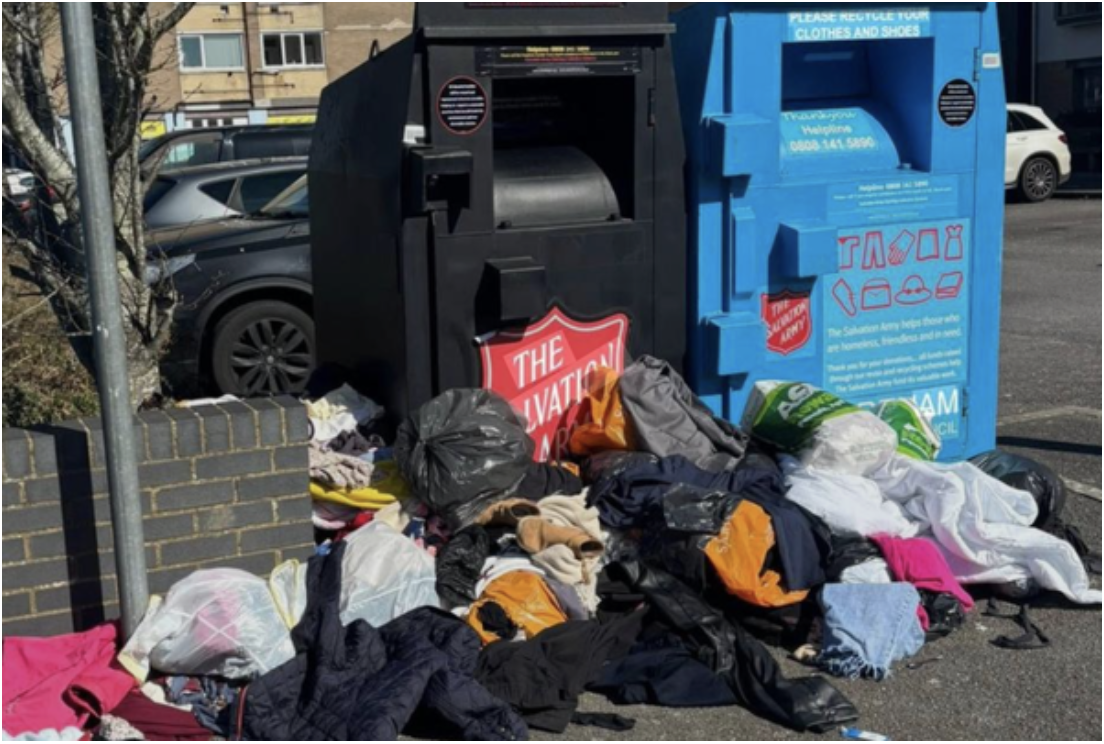
For years I have always put soiled or damaged items into my household waste bin. I can imagine many of you reading this do the same. But that will be because you work in the apparel industry. That's not what your average consumer does.
Unfortunately the meeting I was really hoping to happen last week, between charity shop managers, Green Party Councillors and The OR Foundation didn't materialise because of, well, heat. But the conversations I had running up to this paint a picture much worse than I had previously thought possible.
The first port of call for anyone whose got an item worth reselling it's Vinted. Charity shop managers in my local area, which has a higher disposable income than the average area in the UK, have said this has contributed directly to them getting poorer quality donations. And it's always a consumers first port of call for mid level products. Many expensive, designer items are likely to go on a rental platform to maximise their value. Which, in a cost of living crisis, is understandable from a consumer perspective.
These new ways to generate income for individuals has impacted the clothing being donated to charity shops. Not in terms of quantity, which is on the rise by 10-15%, as estimated by my local charity shops. But in terms of the quality. With an estimated 25% now going into the "waste" stream. And these numbers are being forecasted to rise. You can read a statement on this from The Salvation Army here.
(It would be remiss of me not to mention that there are other trends at play which always filter into second hand. The current "Ozempic" trend has seen an short term increase in larger sizes, and better quality clothes, coming through in the first half of this year. And so my comments around quality of donations is not as black and white as it seems.)
Even more concerning that the rise in both donations and waste, is the reduction in the money charity shops get from "recyclers", which has decreased by around 80% in the last 4 years. One charity shop showed me their accounts, where they received £25 for roughly 400kg last month, compared to £135 for just over 300kg 4 years ago.
Just as all trends aren't the same. Neither are charity shops. Some are behemoths with complex retail strategies, and avenues, not too dissimilar to retail giants like Marks and Spencer. Others, like the Salvation Army have embedded themselves further down the waste stream, which has seen their income rise by $2 billion per year since 2022. A % increase similar to that of Cancer Research, who are one of those behemoths. But a huge gap away from Oxfam, whose income has only increased 2.7% in the same period. Or the RSPCA, which manages a franchise structure, which has seen a 1.7% decline.
Clothes that don't get resold or sent to charity, become a local government problem. Not that the head of Waste Management in my regional area think that it is a problem because they "have a contract with Biffa who manages that". In my area not all our household tips have textile waste bins. My local tip direct soiled products to household waste (landfill / incineration), and direct people to the Salvation Army bins at the supermarket down the road for resellable products. The tips that have a textile waste bin go to Biffa, who then send it to The Salvation Army.
I know an awful lot of people who don't understand the complexity of textile waste, and think that if they put their soiled textile in the bin at the tip, they'll be recycled into new items. Whereas I know that textile waste from my town is ending up at Kantamanto market because of this waste stream.
*I say "I know" like I can prove it. I can't. And I can't because export documents in the UK are confidential information. I even tried asking a friend who manages the port authority if I could sneakily find out if a subsidiary of The Salvation Army called Kettering Textiles was exporting to Ghana. He said there was no way for me to get that information. So I don't know, but I would bet a decent stack of cash on it.
Now, we get to the real problem with textile waste. Kantamanto market is the largest second hand market in the world, as is largely seen as the gateway to Africa for second hand goods. The price of the 55kg bundles paid for by the retailers, designers and tailors there is rising faster than the price decline in the UK. This isn't greed, although some of the other issues these business face are, much of this price rise is to do with duty increases designed to limit the trade deficit.
We all know the narrative of Trump's tariffs. Let's make sure we apply the same narrative to both the US and Ghana. And ask ourselves why the Ghanaian government may want to reduce imports?
The tariffs are the first sign of a problem. The next sign that the shit is really close to the fan, is when the industry this impacts the most goes on a PR defensive. Let's look at a couple of messages doing the rounds at the moment, and decide for yourself as to how bad this really is.
First we have report put out by the UK International Development agency to look at the quality of second hand clothing being donated in the US and sent to Uganda and Tanzania. Most obvious is that US customers are not the same as UK ones. And their national infrastructure is different to ours. It's like comparing apples and oranges because they are fruits.
The second issue I take with this report is that they are not holding the same weight to different points of measurements. Just because something is durable doesn't mean it's suitable for the climate.
Yet it was a point in the conclusion that gave me chills. It summarised that an exporter could not be held liable for any products that were dumped for being unsuitable, or unsellable, because it was the importing country's government who was responsible for the disposal of the waste being sent to them.
Which seems to me to be at massive odds to this idea of the polluter pays principle the same people are pushing onto brands that make rubbish. The very people pushing the narrative that the waste textiles being sent abroad are not the responsibility of the sorter. Are the same people who would financially benefit from an Extended Producer Tax applied to Shein products.
Ain't capitalism grand, folks!
(Credit where credit is due, the report does highlight a couple of really important, positive points, around economic responsibility and that microfibre pollution could not possibly be the responsibility of anyone else but the brand.)
We then come onto some much more egregious. In fact, it's straight out of the British Colonial playbook.
Gaslighting.
The Head of the Textile Recycling Association in the UK has taken to Linkedin repeatedly over the las few weeks to claim there is no textile waste problem in Ghana, and actually its not clothes but plastic packaging.
This directly contradicts the lived experiences of those in Kantamanto, and the activists and journalist who have visited the area to raise awareness through The OR Foundation. Luckily, we have social media. And the videos / photos The OR Foundation put out on their instagram.
I've said it before, and I'll say it again until there is no breath left in me; we live in a post truth world. If we ignore the voices of those on the ground we will drown them in clothing. Or they will ban imports from us and we will drown in our own waste. Either way, at that point, it's just too damn late.