Trademarks, Patents and Common Sense as a Legal Argument
Laws are a funny thing. Because while we are constrained by them, we can only be constrained by them if we agree to them. Or rather, if the majority of society will agree to them. Another fact is that laws, or legistlation, are guidelines. It's the courts that set the precedent. In the last couple of weeks I've read lawsuits that cover trademarks, patent infringement and, "common sense" being used to terminate a contract without repercussions. Begging the question; how small do you need to be to lose? And what happens if we (the majority) don't agree with it anymore?
Let's start with the one you've probably read about. Patagonia, the outdoor brand named after a region covering the Andes Mountains, is threatening legal action against environmental drag activist for using their brand Pattie Gonia for merchandise. Now, for context, Pattie Gonia said to the brand, back in 2022, that they would not sell merchandise. But we all know that strategies change, as our "common sense" lawsuit, below, will tell.
Now, a lot of the recourse is around logos. Something which the US Patent office did not find confusing. Although, I will leave it to you to make up your mind.
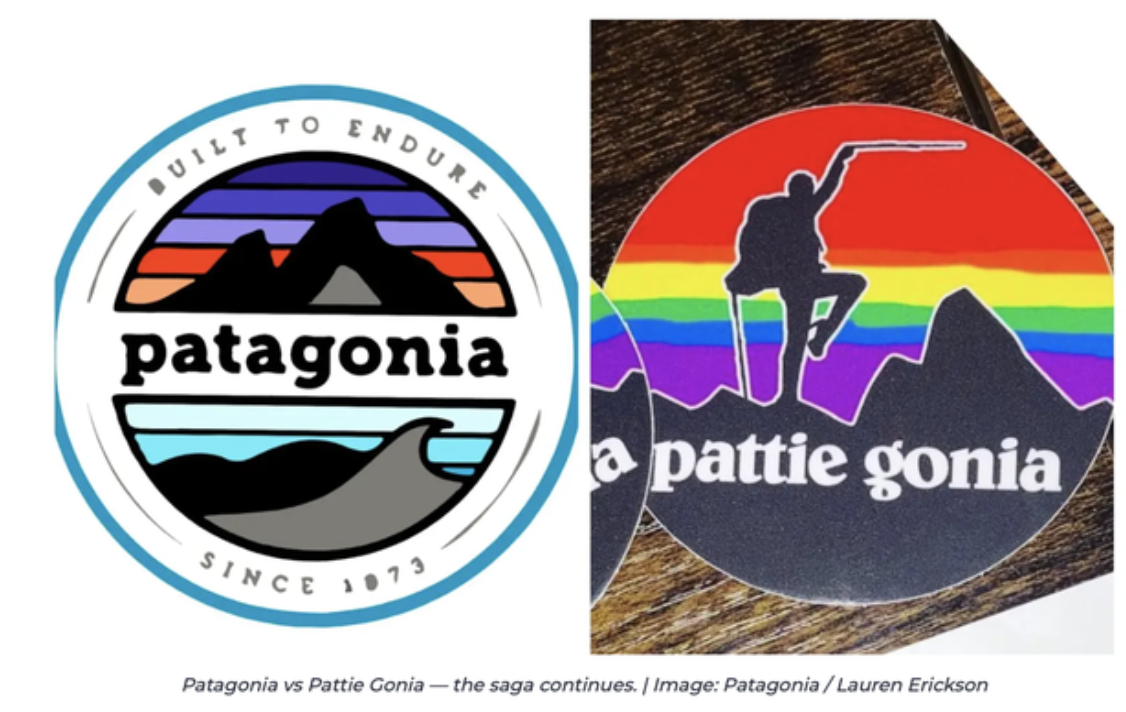
A fun fact, however, is that Patagonia make new outdoor clothing. At present, Pattie Gonia screen prints onto recycled clothing. Not new clothing made out of recycled textiles. Recycled clothing. While there is no doubt that an expansion plan is in place. Realistically, how infringed are Patagonia likely to be from merchandise created by a drag artist?
Intent is key, no?
And with that question we move onto the patent infringement. Shock Absorber, the revolutionary sports bra brand owned by Champion Sports, has infringed on a patent from another revolutionary sports brand, Maaree, who has a patented overband support system. Maaree turned over just over £300k in the year to April 2025. While we don't know Shock Absorber's annual turnover, it's estimated to be around £10 million per year. Just to give you an idea how big Goliath is!
Initially, when the founder of Maaree reached out to Champion, they said they would not sell the sports bra they ripped off from her in the UK. It has since been discovered that it is available for retailers in the UK to buy wholesale. Champion has not responded to the founder since this discovery.
It's easier to get away with design infringements today than 20 years ago. Those of you old enough may remember that River Island used to rip off All Saints designs, and then would pay All Saints out of court settlements. A friend, who was a buyer at RI at the time, said they had a fund just for this! This is where intent to copy needs to be proven. Which, fortunately for Maaree, there is the evidence, as a Shock Absorber employee ordered the copied bra to the brand's office!
Clearly much has changed in the last 12 years, when I worked for large brands you had to make sure no one could trace an "inspiration" sample back to the company!
However, how can a brand turning over so little compete against a brand that can bankrupt them in the court system? It's an interesting role reversal from Patagonia's trademark infringement. If both the large brands win, what does that mean for the rest of us?
This brings us onto the last legal case, which was heard in the Hague Court of Arbitration back in March between the governments of the UK and Rwanda. Rwanda sued the UK government for breach of contract over the Conservative government's asylum deportation plan. Which absolutely breached human rights at the time. And at a cost of £700 million to deport a grand total of 4 people, makes those hotel stays seem pretty cheap, no?
The Court agreed with the UK that, as Labour had won the general election, it was "common sense" that the scheme would be cancelled. And, while Rwanda's council knew getting a positive result on a breach of contract was unlikely, they did push for renumeration because no negotiations had taken place before outright cancellation. However, "common sense" seemed to be enough to let the UK walk away without paying out anymore money. Which is a win for the UK taxpayer under Labour.
It's worth noting, that in the UK and the US, you can cancel a contract without financial burden for a change in business strategy (although please check the wording in your contracts with a lawyer!). This fact alone helps Pattie Gonia with their lawsuit, because strategies have clearly changed between 2022 and 2026. And the law allows them to do that.
Intent forms the basis of many arguments, not just within brand protection, but also within ethical and sustainable fashion. Heck, it also forms the basis of most moral arguments as well! For me, it doesn't read that Pattie Gonia intends to look like Patagonia. It does seem that Shock Absorber did intend to rip off Maaree's designs. And the UK's Conservative government did intend to breach human rights laws and the Labour government intend not to.
We could go onto look at older lawsuits, such as the one being taken against Tesco and Intertek for human rights infringement. What is the intent of Tesco in employing Intertek? And what was Intertek's intention when undertaking an audit? And what was the intent of the Thai legal system to rule in favour of Tesco and Intertek when the manufacturing facility had the intention of fooling the Intertek auditors?
Our legal system is supposed to untangle these things and rule with fairness. How the legal system plays out with the business dealings of both Pattie Gonia and Maaree is likely to give us insight into how capitalism over the next decade is going to play out.
I'd like to end this rather bleak newsletter with a political conversation I had a few weeks back during campaigning. We, as individuals, have a hierarchy of needs. Water, food, shelter being the most important. For governments the bottom of the hierarchy of needs is energy and money. There are many different levers a government can use to balance those 2 needs. One that is considered is a reduction in human capital hours. On the Left this looks like a 4 day working week and a tax rise. Everyone in it together, and a push for spending through increased leisure time. On the Right, it's trad wives and a tax on the childfree. A not so in it together approach. But the outcome for governments remains the same.
So, the last question I have for you is, if the outcome rules in favour of the large brands in both scenarios; how are we, as consumers, activists, journalists, employees, going to engage with a world that no longer sells the dream of working towards a better life?