Can Clothing Performance Really be Tested in a Lab?
At a time when well know fabric suppliers, such as Polartec and 37.5, are moving away from lab testing to determine how a fabric performs, the JRC have released their latest DPP (Digital Product Passport) guidance which promotes lab testing. In a world of incredibly complex performance factors, how is this likely to play out?

Let's start with the good news! Based on the JRC's latest guidance, there are only going to be 3 data points to ensure product compliance. And this is based on a legal guarantee of a product lasting 2 years of use, under the Empowering Consumers Directive.
Now, using time as a measuring factor can be tricky. A formal dress, for example, will probably only be used a handful of times in 2 years. So the durability standards are lower than a pair of jeans, which, based on reasonable use case, could be used once a week.
Another example is, an entry level pair of cycling shorts wouldn't be expected to be worn on a 100km ride every weekend. But a mid range pair of cycling shorts with a long distance pad in, could reasonably be considered to need to do more than 120km every month. Why not every week you ask? Well, it would be reasonable to assume that someone that dedicated to cycling would have more than 1 pair of cycling shorts.
The 3 tests the JRC are proposing are; appearance after wash based on ISO 15487, spirality based on ISO 16322-3 and, dimensional change based on ISO 3759.
ISO standards are just the test method. They don't advise what the score should be. The appearance after wash is graded 5 -1, with 5 being the best and 1 being the worst. Spirality and dimensional change are reported in %. The lower the %, the better the product. In theory.
Tying off the good news here: we aren't going to be seeing mandated testing such as abrasion resistance and tear strength, which synthetics perform better at than natural fibres (providing they're made correctly, which if you read my newsletter last week about the Liverpool shirt, you will know isn't always the case! The photo below indicates that the appearance after wash would score a 1 for this!). And this was a concern for many people.
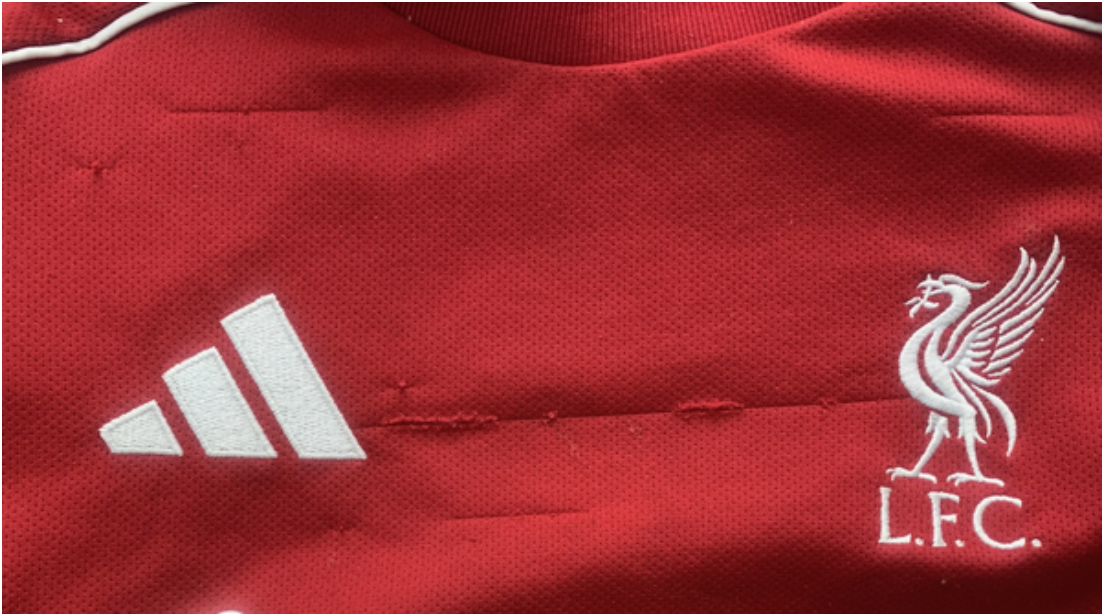
But why am I suggesting these methods, specifically the ones measured in %, may not be quite as telling as we hope?
The problem comes down to consumer's understanding of how a product is developed. It has been found in scientific studies that organic cotton has a higher spirality than conventional cotton, and so does mechanically recycled cotton. Short answer is because the fibre lengths are shorter, so there needs to be a higher twist in the yarn. On the DPP you will be able to see the % of recycled / organic content and the % of spirality, but no information on why the numbers are what they are.
It's the short answer because improvements can be made on the spirality by the method you use to spin the yarn in the first place. For cotton you have rotor spinning, or ring spinning. Ring spinning creates a better product, but rotor spinning is a lot cheaper. If you want to delve into the differences, this article is pretty good.
Then there is finishes to consider. Some resin based finishes may be applied to improve the appearance after wash score, that can degrade the fibres over time. Making them weaker and prone to tearing. This is where my brain combusts. I just don't understand chemistry, so I go to other people for this. In case you thought I was about to drop something really insightful!
And then there is how something is knitted or woven. Circular knitted single jersey cotton would have a worse spirality than warp knitted cotton. Now, guess which process is cheaper!
(Now, I know I'm going to get some emails on this from a few people, you know who you are! So I will caveat by saying that yes, correct finishing drastically reduces spirality on circular knits. But how many people actually check that before production? Yes, I know you do! But the amount of times I've been asked to help get a refund on cotton jersey that's twisted by 12% after 1st wash, is silly. And no, it wasn't a cotton jersey I sourced!)
All of this is, of course, based on 100% cotton. The easiest, and cheapest, way to improve the spirality score is......
Add polyester!
Which brings is onto why Polartec and 37.5 are moving away from lab testing (which ISO standards are designed for) and into product testing out in the 'wild'. Ultimately lab testing is designed to compare items under the same conditions. But they don't tell you how something will perform when you stick a human in it.
Take a waterproof hydrostatic head rating of 10,000mm. That tells you how much water pressure a fabric can sustain until 3 drops come through the fabric. But someone whose 100kg, kneeling on the ground, is going to have wetter knees sooner than the 60kg person. It helps the individual compare items, but it doesn't tell them how a product is going to perform for them.
It gets a whole lot more complicated when it comes to breathability. Which is largely a test I ignore on a product spec. The only time I look at it is in relation to the hydrostatic head to determine if the product will hold up better when submerged in water (a lower breathability rating that waterproof), or if it's designed for high cardio sports (a higher rating than waterproofness). That then needs to be tested in product form. As every individual is unique is how much they sweat and where.
Now we come to one of my biggest bugbears. And it's not calling bamboo a sustainable fibre! Its when polyester is used to make a garment and then that garment is Dry Clean Only!
Honestly, hands down, the most pointless and environmentally damaging product there is. But, it won't half score well on product compliance.